
Northumbrian Smallpipes
Northumbrian smallpipes
| Category | Wind |
|---|---|
| Country of origin | Northeast England |
| Wikipedia | en.wikipedia.org |
| Wikidata | Q1046018 |
Overview
The Northumbrian smallpipes are a bellows-blown bagpipe from the northeast of England, with a closed-end chanter that can play single notes detached from one another rather than a continuous drone-on-drone sound. This single design choice — a stopped chanter, in which lifting one finger sounds a note and lowering all fingers stops the air — gives the Northumbrian smallpipes a unique staccato style that no other bagpipe in the British Isles shares.
Wikidata describes them as bagpipes from northeast England that are bellows-blown, classed as a single oboe with cylindrical bore and a set of single-reed pipes.
Origin & History
Bellows-blown small bagpipes are documented in northeast England from at least the 17th century. The early Northumbrian instrument was a simple, mouth-blown or bellows-blown pipe with a closed chanter, two or three drones, and a relatively limited range. Surviving 18th-century instruments are rare, and most of what is known about pre-1800 Northumbrian piping comes from manuscripts of the same period — particularly the William Dixon manuscript of 1733 — and from the rich repertoire of variation tunes that survives in Northumbria.
The instrument was transformed during the 1800s by the makers John Dunn, by Robert Reid working with his son James, and later by Robert Robson. Through a sequence of incremental improvements between roughly 1800 and 1860, they added keys to the chanter to extend its range from one octave to nearly two and to make it fully chromatic. The result was an instrument capable of playing not only the local folk repertoire but also concert music, hymn tunes and even some classical excerpts.
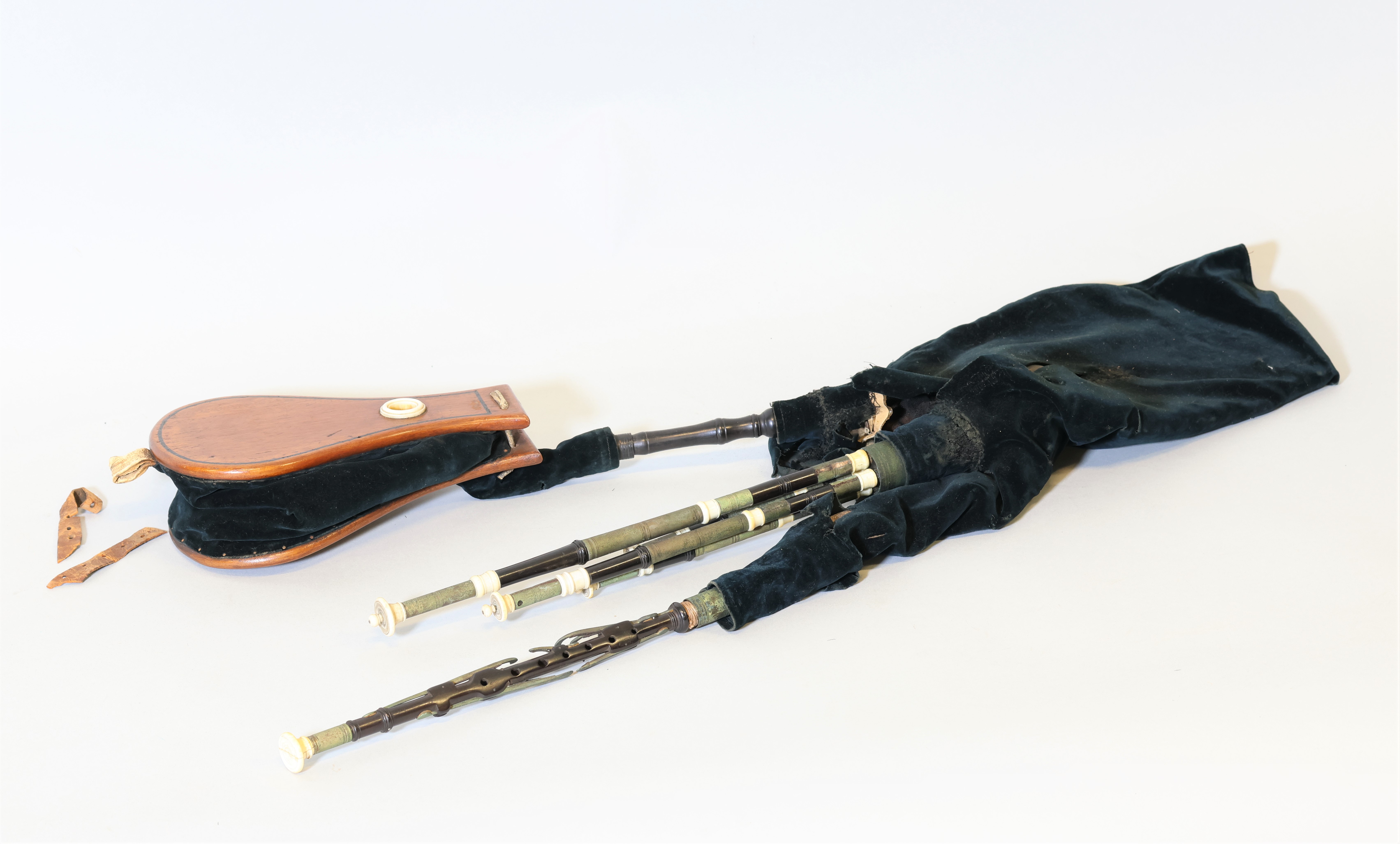
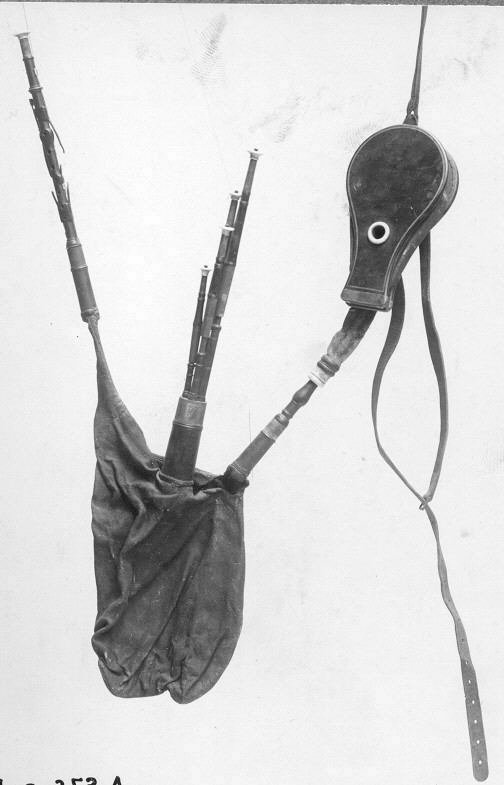
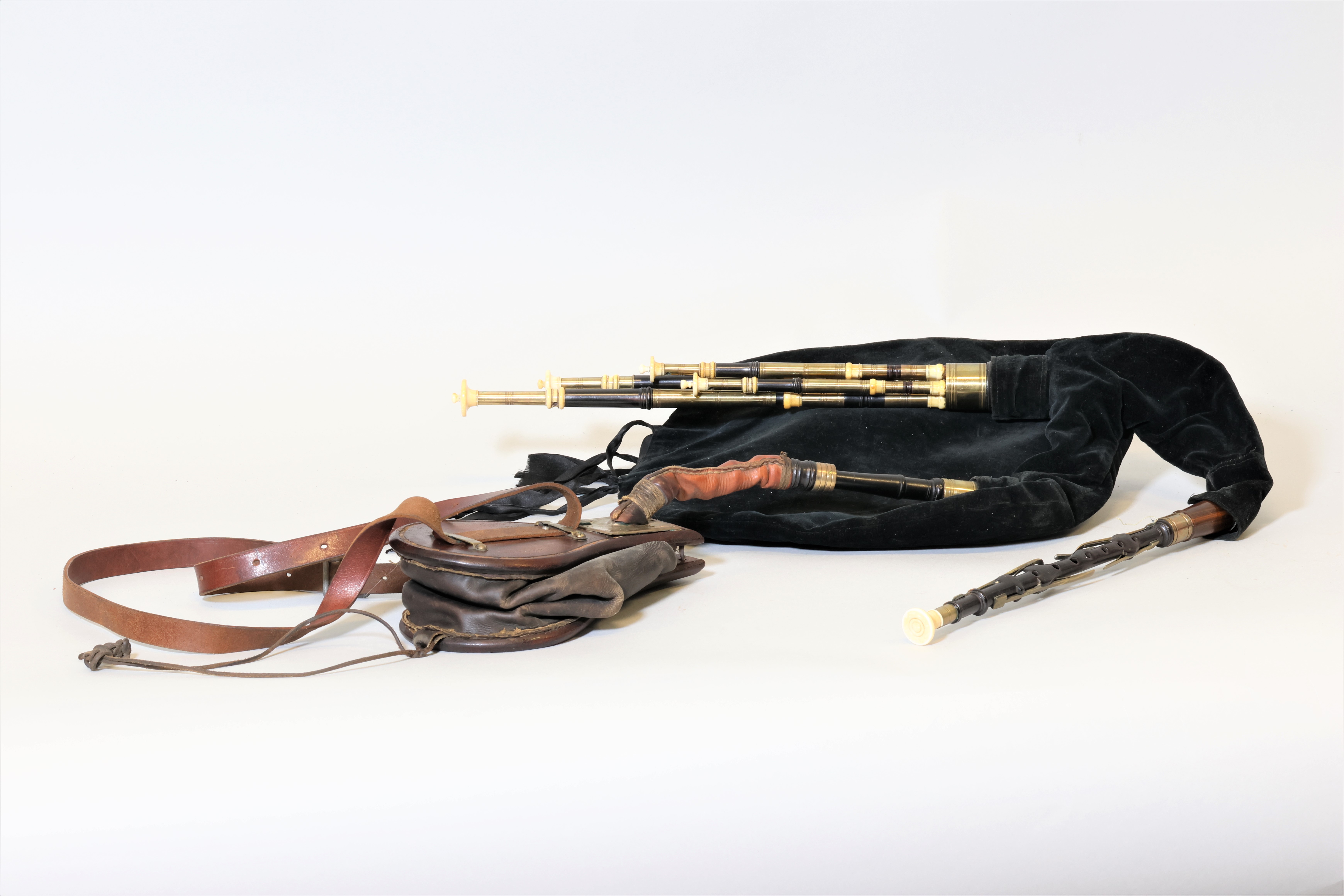
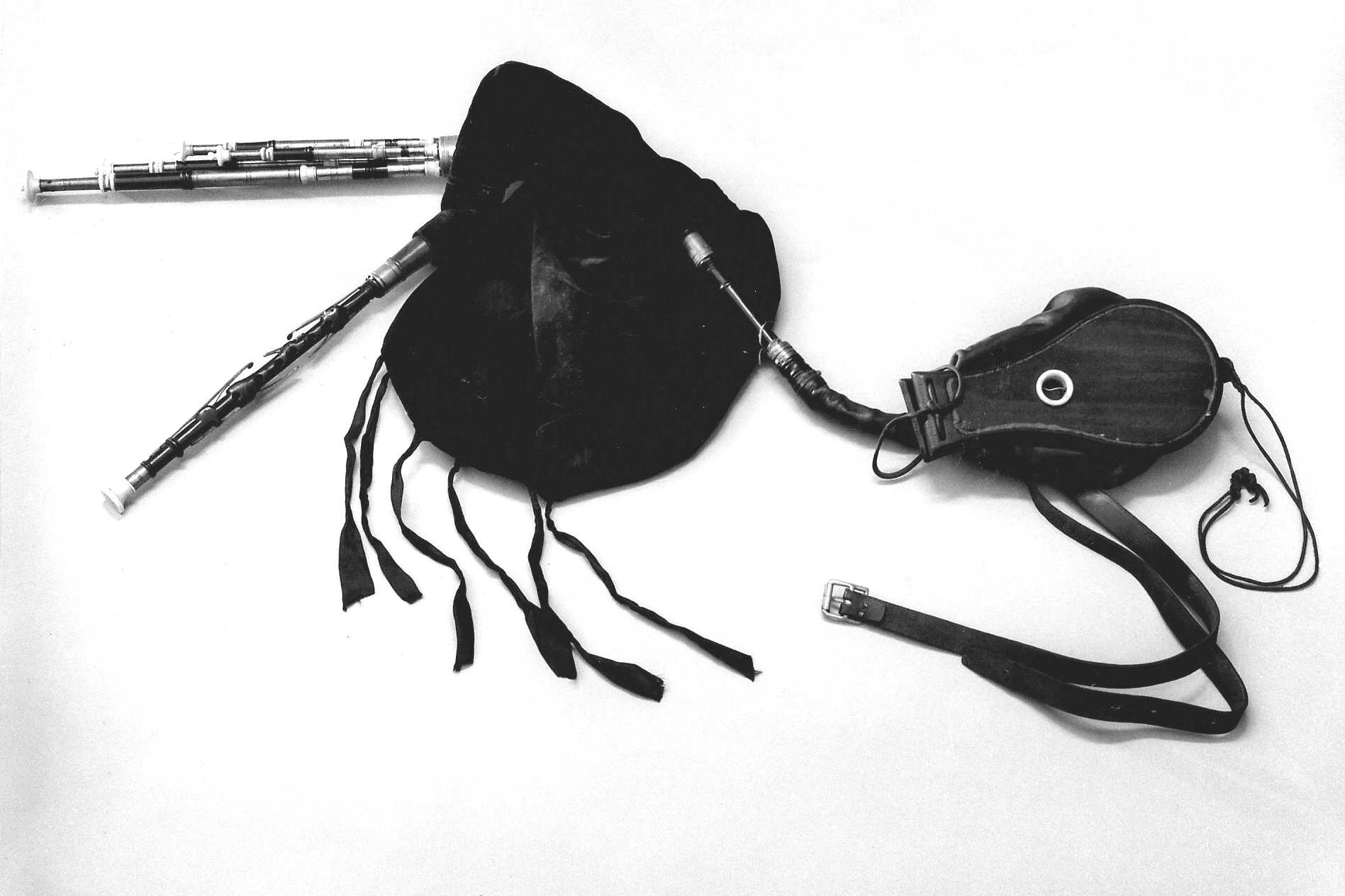
The Metropolitan Museum’s collection holds two Northumbrian smallpipes that bracket this reform period. A British instrument of around 1810 (object 503801) — built of wood, ivory, brass, leather, velvet and sheepskin, donated by Burl Ives in 1963 — represents the early, less developed form. A later instrument from after 1867 (object 502087), of wood, leather, ivory and brass, donated through the Crosby Brown Collection in 1889 and described in the catalogue as Scottish, dates from after the Reid-Robson reforms had taken hold. Both are catalogued as Aerophone-Reed Vibrated-bagpipe.
The instrument was preserved through the late 19th and early 20th century by a small group of enthusiasts in Northumberland and Newcastle, and the formation of the Northumbrian Pipers’ Society in 1928 secured its modern continuity. From the 1960s folk revival onward the smallpipes have spread well beyond their home region; the Society now has members in dozens of countries.
Construction & Materials
The Northumbrian smallpipes consist of a leather bag, a small set of bellows worked under the right elbow, a cylindrical-bore chanter and three or four drones tuned in fifths. Air is supplied by the bellows rather than by mouth, which means the player can sing or speak while playing — an important practical difference from the Highland pipes — and the reeds stay drier and last longer.
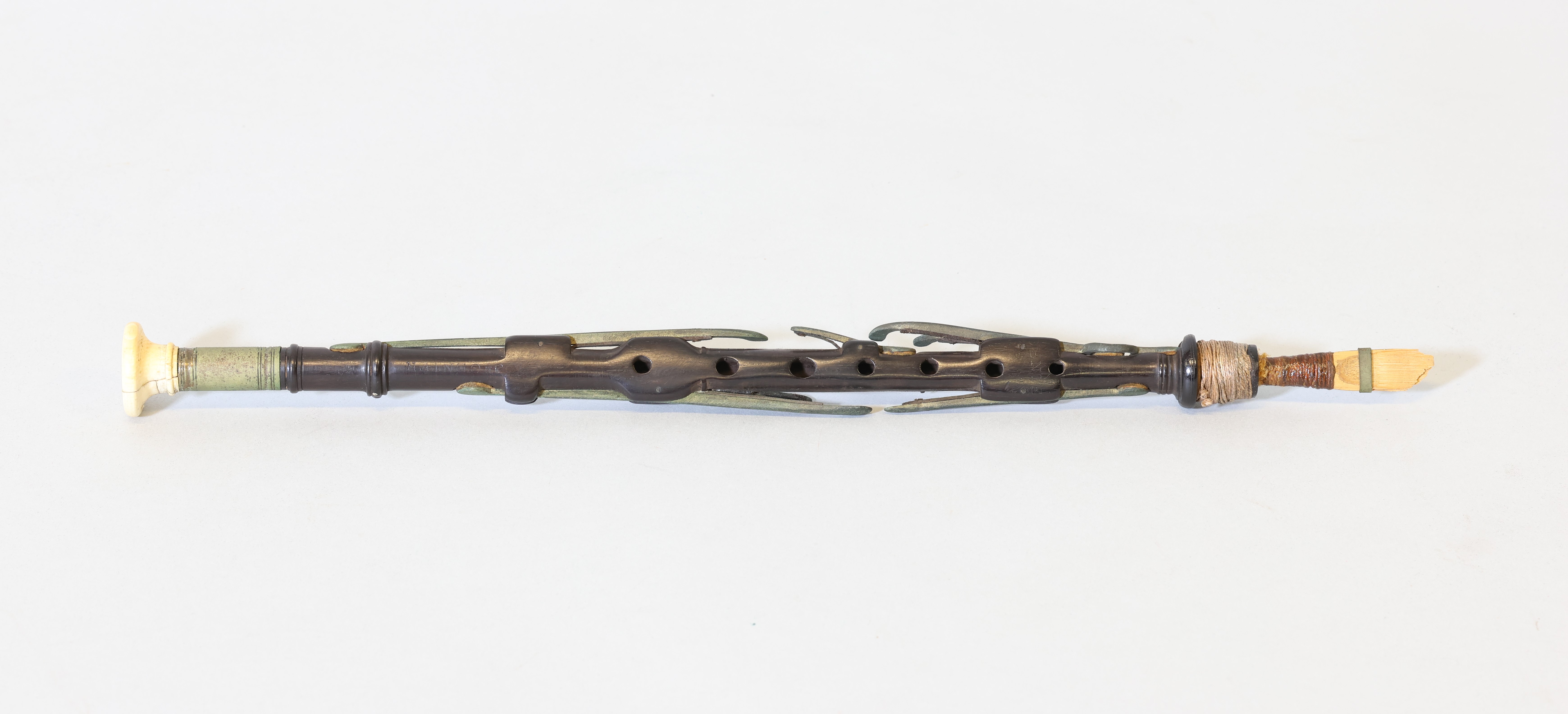
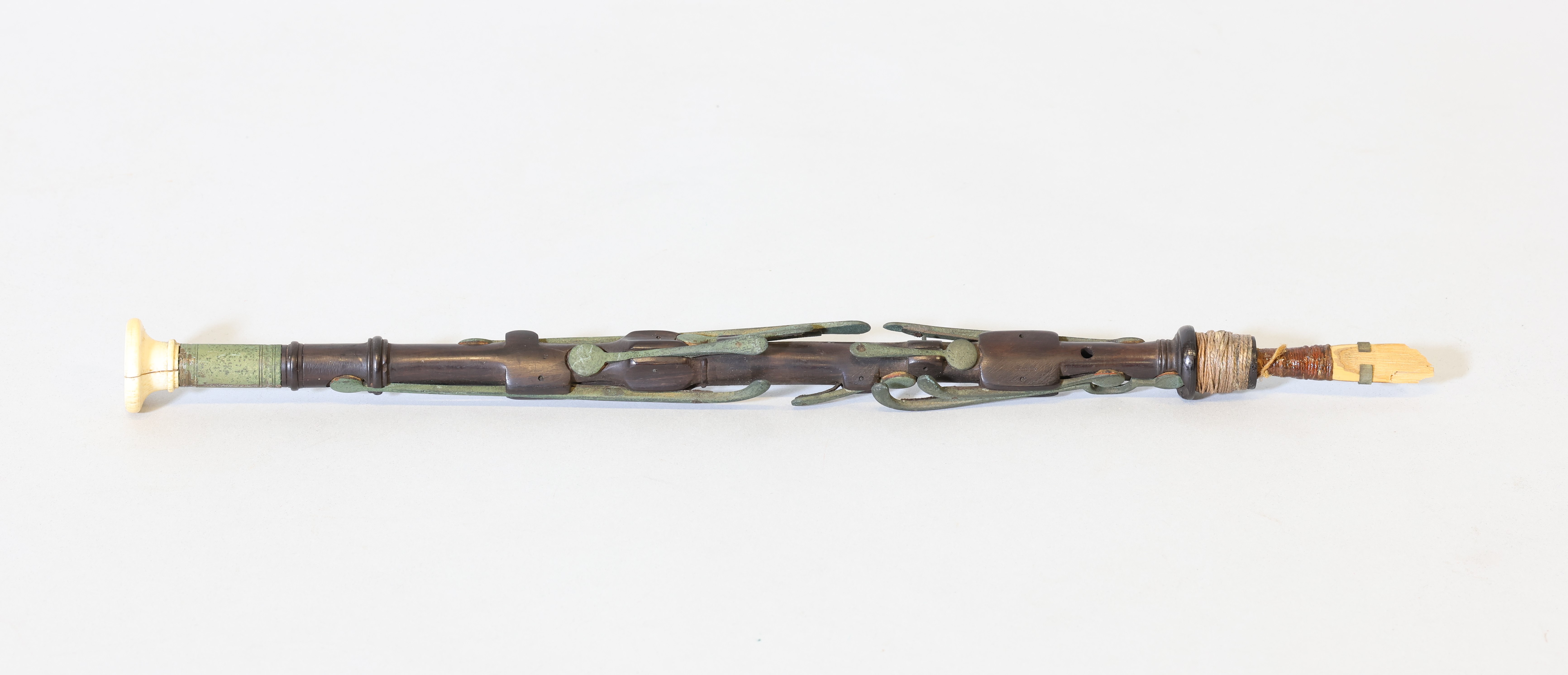
The chanter is the defining element: a closed-end cylindrical pipe with seven finger holes and, on a fully developed modern instrument, between seven and seventeen keys. The closed end means that lifting one finger produces one note, and lowering all fingers silences the chanter — making the Northumbrian piper able to articulate detached notes, rests and ornaments in a way that no Highland or Irish piper can.
Tonewoods include blackwood, cocus, boxwood and rosewood; ivory and brass are common for mounts and key work, with synthetic substitutes on modern instruments. The MET specimens use period-appropriate materials including ivory and velvet on the bag covers.
How It’s Played
The piper sits with the bag under the left arm and the bellows under the right elbow, pumping the bellows in slow steady strokes while squeezing the bag in alternation to maintain constant pressure. The left elbow controls bag pressure; the right hand and arm work the bellows; the fingers of both hands work the chanter and any closed keys.
The signature articulation is the closed style: every note is a single attack, with the chanter falling silent between notes whenever all fingers are down. Skilled players use this to produce intricate ornament patterns — the grace, the swirl, the cut — that make the Northumbrian repertoire one of the most ornamented in British folk music.
Cultural Significance
The Northumbrian smallpipes are the cultural symbol of the historic Northumbrian region, much as the Highland pipes are of Scotland and the uilleann pipes of Ireland. The repertoire — Felton Lonnen, Chevy Chase, Whittingham Green Lane, The Keel Row — preserves the dance and ballad music of the Border lowlands and the coastal coalfield in a more direct way than almost any other surviving British folk repertoire. Through the 1800s the instrument was particularly associated with the household pipers of the Northumberland ducal seat at Alnwick Castle, a patronage line that continued unbroken into the 21st century.
The Northumbrian Pipers’ Society in Newcastle, the Morpeth Northumbrian Gathering, and the Allendale and Rothbury folk festivals form the modern cultural infrastructure of the tradition. The Society’s Pipemakers’ List and tutor publications have made the instrument accessible to learners worldwide.
Notable Examples & Recordings
The MET’s two specimens (objects 502087 and 503801) document the late Georgian and high-Victorian forms of the instrument. The Morpeth Chantry Bagpipe Museum holds the world’s largest collection of Northumbrian smallpipes and related bagpipes.
For listening:
- Kathryn Tickell, On Kielder Side and later albums — the leading modern Northumbrian piper, who has carried the instrument into folk, classical and jazz contexts.
- Pauline Cato, The Wansbeck Piper — strong representation of the traditional repertoire.
- Billy Pigg — historical recordings of one of the great early-20th-century traditional players.
- Andy May, Whatever the Weather — contemporary playing including original compositions.
Related Instruments
- Bagpipe – the wider global family of which the Northumbrian smallpipes are one regional form.
- Uilleann Pipes – the Irish bellows-blown pipes; a parallel development with an open chanter and very different sound.
- – the bellows-blown Scottish pipes that revived from the 1980s, partly modelled on the Northumbrian.
- – the late-18th-century English bellows-blown pipes that contributed to the development of both the Northumbrian and the uilleann pipes.
- Border Pipes – the louder bellows-blown pipes of the Anglo-Scottish Borders.
Where to Hear It
The Morpeth Northumbrian Gathering in April is the largest annual Northumbrian smallpipes event. The Rothbury Folk Festival and the Whitby Folk Week both feature substantial Northumbrian piping. The annual recital and AGM of the Northumbrian Pipers’ Society in Newcastle, and the regular sessions at the Cumberland Arms in Newcastle, give the tradition continuous live presence.
- Wikipedia: Northumbrian smallpipes
- The MET: Northumbrian Small-Pipe (object 502087)
- The MET: Northumbrian Small-pipes (object 503801)
- Wikimedia Commons: Northumbrian smallpipes
Learning Resources
The Northumbrian Pipers’ Society publishes the standard tutor (the NPS Tutor) and maintains a list of approved makers. A starter set of practice pipes (chanter and bag without drones) is the usual entry point for beginners and can be bought new for around 800 GBP; a complete F or G smallpipe by a leading maker such as Mike Nelson, David Burleigh, Colin Ross or Ray Sloan typically runs from 2,500 to 5,000 GBP. The Society runs annual workshops in Northumberland and online classes for members.
Frequently Asked Questions
Are the Northumbrian smallpipes the same as the Highland pipes?
No. The Northumbrian smallpipes are bellows-blown rather than mouth-blown, much quieter, with a closed chanter that allows detached articulation, and a fully chromatic keyed chanter on developed instruments. The Highland pipes are mouth-blown, very loud, with an open chanter that produces a continuous melodic line and a limited fixed scale.
Why are they called “smallpipes”?
The instrument is small in physical dimensions, low in volume and intended for indoor playing. The name distinguishes it from the larger and louder Border pipes and Highland pipes.
Where were the Northumbrian smallpipes invented?
They developed in the northeast of England, particularly in Northumberland, from the 17th century onward. The fully keyed modern form was created by the Reid and Robson families of pipe-makers in Newcastle and North Shields between roughly 1800 and 1860.
Are old Northumbrian smallpipes in museums?
Yes. The Metropolitan Museum holds two specimens: a British instrument of around 1810 (object 503801) and a later set from after 1867 (object 502087), both in the Musical Instruments department. The Morpeth Chantry Bagpipe Museum in Northumberland holds the largest dedicated collection.
Is it possible to learn the Northumbrian smallpipes outside the UK?
Yes. The Northumbrian Pipers’ Society has members in dozens of countries and offers tutor materials, online classes and contact with local players worldwide.


