.jpg)

Pan Flute
Pan flute / Syrinx
| Category | Wind |
|---|---|
| Country of origin | Worldwide (independent origins on multiple continents) |
| Classification | family of musical instruments |
| Wikipedia | en.wikipedia.org |
| Wikidata | Q218802 |
Listen
Audio: CC0 / via Internet Archive

Overview
The pan flute is a wind instrument formed by tying together pipes of graduated length and blowing across the open upper end of each pipe to produce a different pitch. The Wikipedia summary describes it as a simple woodwind musical instrument formed by tying various lengths of pipe together, now typically made from bamboo. The Hornbostel-Sachs scheme files the pan flute among the duct flutes and end-blown flutes; the more specific Wikidata classification places it as an open raft panpipe (the pipes lie side-by-side and parallel) or, less commonly, an open bundle panpipe (the pipes are tied in a bunch).
The pan flute is one of the most widely distributed instrument families in the world. Independent regional traditions exist in the Andes (the zampoña and siku), in Romania and the Balkans (the nai), in China (the paixiao), in Greece (where the instrument took the names syrinx and gave the family its Western name through the myth of Pan and Syrinx) and in Melanesia (the Solomon Islands and Papua New Guinea bamboo pan-pipe ensembles).
Origin & History
Archaeological evidence indicates independent invention of the pan flute on multiple continents. The Andean antara and zampoña traditions are documented archaeologically by ceramic and bone pan-pipes from the Caral culture of Peru (around 2500 BCE), the Nazca culture (200 BCE–600 CE) and the Moche (200 BCE–700 CE), with surviving specimens in major Latin American museum collections. The Chinese paixiao is documented in bronze and ceramic forms from the Han dynasty (206 BCE–220 CE) and was a standard instrument of the Han court orchestra. The Greek syrinx is documented in Bronze Age and Classical Greek depictions and gave the instrument its Western name through Ovid’s account of the nymph Syrinx transformed into reeds to escape Pan.
The Romanian nai developed independently as a refined art-music form during the medieval and early modern periods and reached its modern 22-pipe configuration through the 20th-century work of master players including Gheorghe Zamfir, who brought the Romanian pan flute to international concert audiences from the 1970s onward.
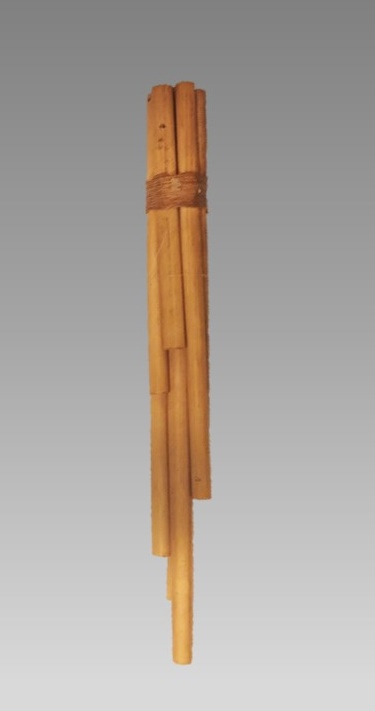
In Melanesia — the Solomon Islands, Vanuatu and Papua New Guinea — pan-pipe ensembles of considerable size and sophistication have been documented since first European contact. The Metropolitan Museum’s collection includes a late-19th-century Melanesian pan pipe (object 501969) from the Bismarck Archipelago of Papua New Guinea, made of bamboo. The Solomon Islands pan-pipe ensembles in particular use pan-pipes of widely varying sizes — from small ones held by a single player to large standing instruments three metres long — to produce polyphonic music of remarkable density.
Construction & Materials
A pan flute consists of a graduated set of cylindrical pipes — typically of bamboo, but historically also of bone, ceramic, stone and (in Andean contexts) of fired clay — closed at the lower end and open at the upper. The pipes are tied side-by-side in a raft configuration (the standard for most pan flutes worldwide) or bound in a circular bundle (less common but found in some Andean and African forms). Pipe lengths are calibrated to produce the desired scale: longer pipes give lower pitches, shorter pipes higher.
Andean zampoñas typically use 13 or 17 pipes arranged in two rows (an arca row with the odd-numbered pitches of a scale and an ira row with the even-numbered pitches), so that two players must alternate to produce a continuous melody — the complementarity (hocketing) principle that is one of the defining cultural features of Andean music. Romanian nais have 20 to 22 pipes giving a chromatic scale across nearly three octaves. Chinese paixiao have 12 or 16 pipes covering a chromatic range. Solomon Islands ensembles use pan-pipes of widely varying sizes; the largest standing ensemble pan-pipes in the au tradition of the Solomons are over three metres tall.
The MET’s Bismarck Archipelago specimen (object 501969) is described simply as bamboo, characteristic of the Melanesian regional tradition.
How It’s Played
The player holds the pan flute horizontally with the pipes vertical and the open ends of the pipes facing upward, and blows across the open upper end of each pipe to produce its pitch. The lips are positioned at the top edge of the pipe so that the air-stream splits across the rim, exciting the air column inside the pipe. Pipe selection is by lateral movement of the lips along the row of pipes.
Idiomatic technique varies considerably by regional tradition. Andean zampoña players use lip vibrato, breath accents and the characteristic complementary hocketing between two players; Romanian nai players use refined breath control and a pitch-bending technique produced by tilting the instrument forward or back to vary the angle of the breath stream against the pipe rim; Chinese paixiao players use a smooth legato style closer to that of the xiao end-blown flute. Solomon Islands ensembles use coordinated multi-player textures of considerable rhythmic complexity.
Cultural Significance
The pan flute carries different cultural weight in each of its regions. In the Andes the zampoña and siku are central instruments of pre-Hispanic origin and remain at the heart of indigenous Quechua and Aymara musical practice; the instruments were inscribed indirectly through UNESCO recognition of Bolivian and Peruvian Andean musical practices. In Romania the nai is part of the national folk-music heritage and the country’s most internationally recognised solo wind instrument. In China the paixiao is a documented court instrument of the Han period and has been revived in the modern Chinese orchestra. In Greece the syrinx is best known through its mythological association with the god Pan and the nymph Syrinx, and this association gave the Western pan-flute family its name.
In Western popular music the Romanian-style pan flute became famous globally through Gheorghe Zamfir’s recordings of the 1970s and 1980s, which brought the instrument’s voice to film soundtracks (most famously Peter Weir’s Picnic at Hanging Rock) and to mass-market easy-listening albums.
Notable Examples & Recordings
- Gheorghe Zamfir, The Lonely Shepherd — defining popular-recording Romanian nai work.
- Inti-Illimani, Canción del Pueblo — Chilean Andean music with extensive zampoña.
- Damaris Mallku, contemporary Bolivian zampoña master.
- Liang Yin, modern Chinese paixiao recordings with the Hong Kong Chinese Orchestra.
- Alaha Vaipua, Solomon Islands au pan-pipe ensemble recordings on the Smithsonian Folkways catalogue.
Related Instruments
- Zampoña – the Andean two-row pan-pipe, played in hocketing pairs.
- Paixiao – the Chinese pan-pipe of the Han court orchestra.
- Nai – the Romanian art-music pan-pipe.
- Quena – the Andean notched-end-blown bamboo flute, often played alongside the zampoña.
- Recorder – the Western duct flute of broadly comparable cultural weight.
Where to Hear It
Andean pan-flute music is heard at folk festivals across Bolivia, Peru, Ecuador and northern Chile, and at international Andean diaspora events. Romanian nai is heard at folk festivals across Romania and Moldova and at Zamfir-tradition concerts internationally. Chinese paixiao is heard in modern Chinese orchestra concerts in Beijing, Shanghai and Hong Kong. Solomon Islands pan-pipe ensembles appear at the Pacific Arts Festival and at occasional international Pacific-music tours. Recordings appear on Smithsonian Folkways, Sublime Frequencies, World Music Network, Naxos World, the Romanian state Electrecord label and the China Record Corporation.
- Wikipedia: Pan flute
- Wikidata: Pan flute (Q218802)
- The MET: Pan Pipes (object 501969)
- Wikimedia Commons: Pan flutes
Learning Resources
Romanian nai pedagogy is concentrated at the Bucharest National University of Music and at the Damian Luca and Nicolae Pîrvu schools in Bucharest. Andean zampoña and siku are taught at the Universidad Mayor de San Andrés in La Paz, the Universidad Nacional Mayor de San Marcos in Lima, and at folk schools across the Andean region. Chinese paixiao is taught at the Central Conservatory in Beijing and the Shanghai Conservatory. Method materials in English are limited; pan-flute methods exist in Romanian and Spanish for the Romanian and Andean traditions respectively. A serviceable bamboo Andean zampoña costs only 30 to 80 USD; a Romanian nai by a recognised maker runs from 200 to 800 USD; concert-grade paixiao from named Suzhou makers run from 300 to 1,500 USD.
Frequently Asked Questions
What is a pan flute?
A wind instrument made of graduated cylindrical pipes tied side-by-side in a raft, played by blowing across the open upper end of each pipe.
Where does the pan flute come from?
From multiple independent regional traditions worldwide. Pan-pipe forms are documented archaeologically in pre-Hispanic Peru (from around 2500 BCE), in Han-dynasty China, in Bronze Age Greece (the syrinx) and in Melanesia. The Romanian nai developed independently as a refined art-music instrument.
Why is it called a pan flute?
After the Greek god Pan, who according to Ovid created the instrument from the reeds into which the nymph Syrinx had been transformed to escape him.
What are the main regional types?
The Andean zampoña and siku (two-row hocketing pipes), the Romanian nai (curved single-row art-music instrument), the Chinese paixiao (Han-dynasty court instrument), the Greek syrinx (mythological and historical instrument), and the Solomon Islands and Melanesian au and similar ensemble pan-pipes.
Is the pan flute easy to learn?
The basic technique of blowing across a pipe is straightforward, but reliable pitch production and clean lateral switching between pipes typically take several months of practice. The Romanian nai’s pitch-bending technique by tilting the instrument is the most demanding aspect for advanced players.


