Shō
笙
| Category | Wind |
|---|---|
| Country of origin | Japan (from Chinese sheng) |
| Wikipedia | en.wikipedia.org |
| Wikidata | Q1975355 |
Listen
Audio: Shoki Recordings, CC BY / via Internet Archive
Audio: Shoki Recordings, CC BY / via Internet Archive
Audio: PD / via Internet Archive
Overview
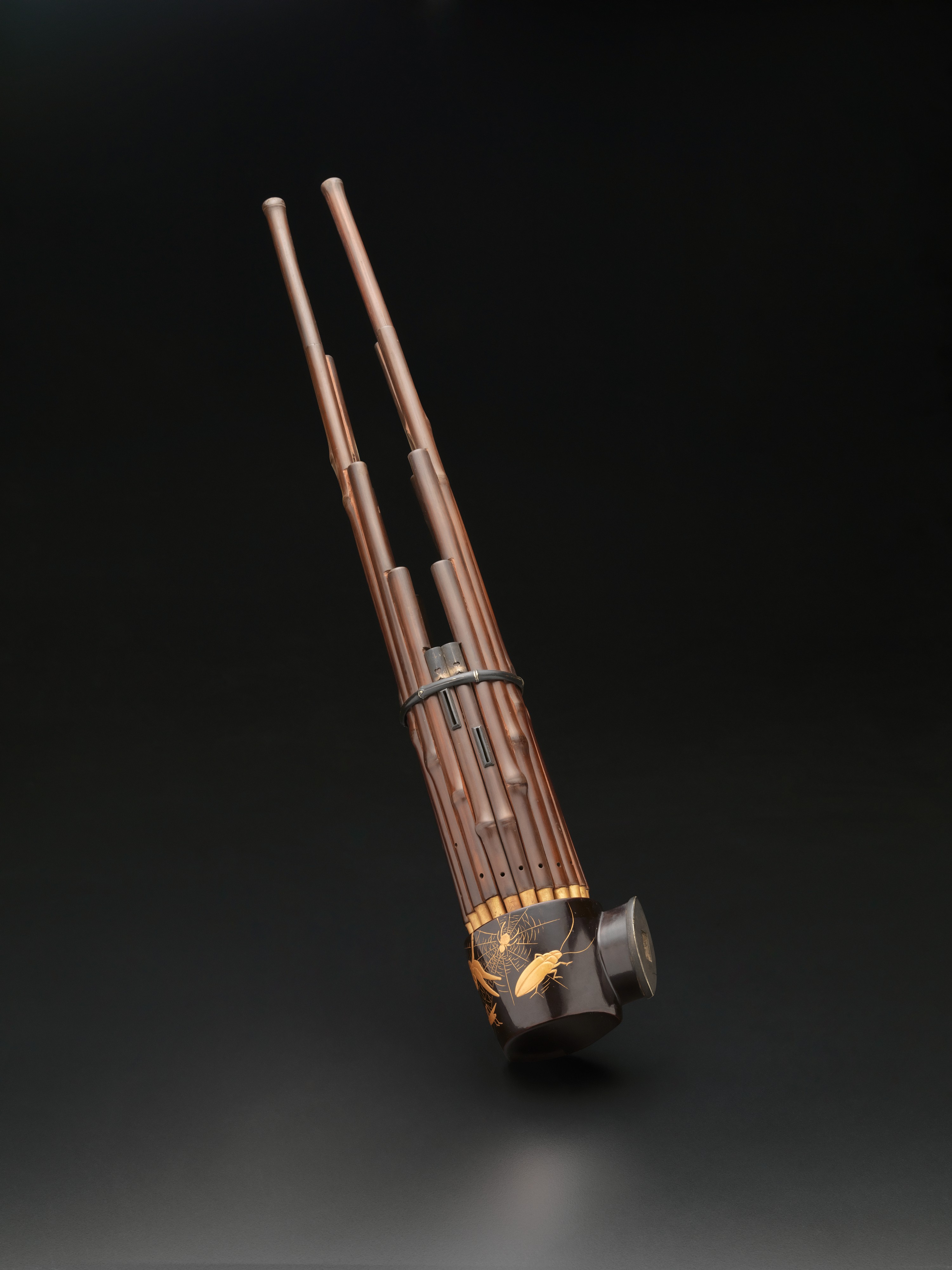
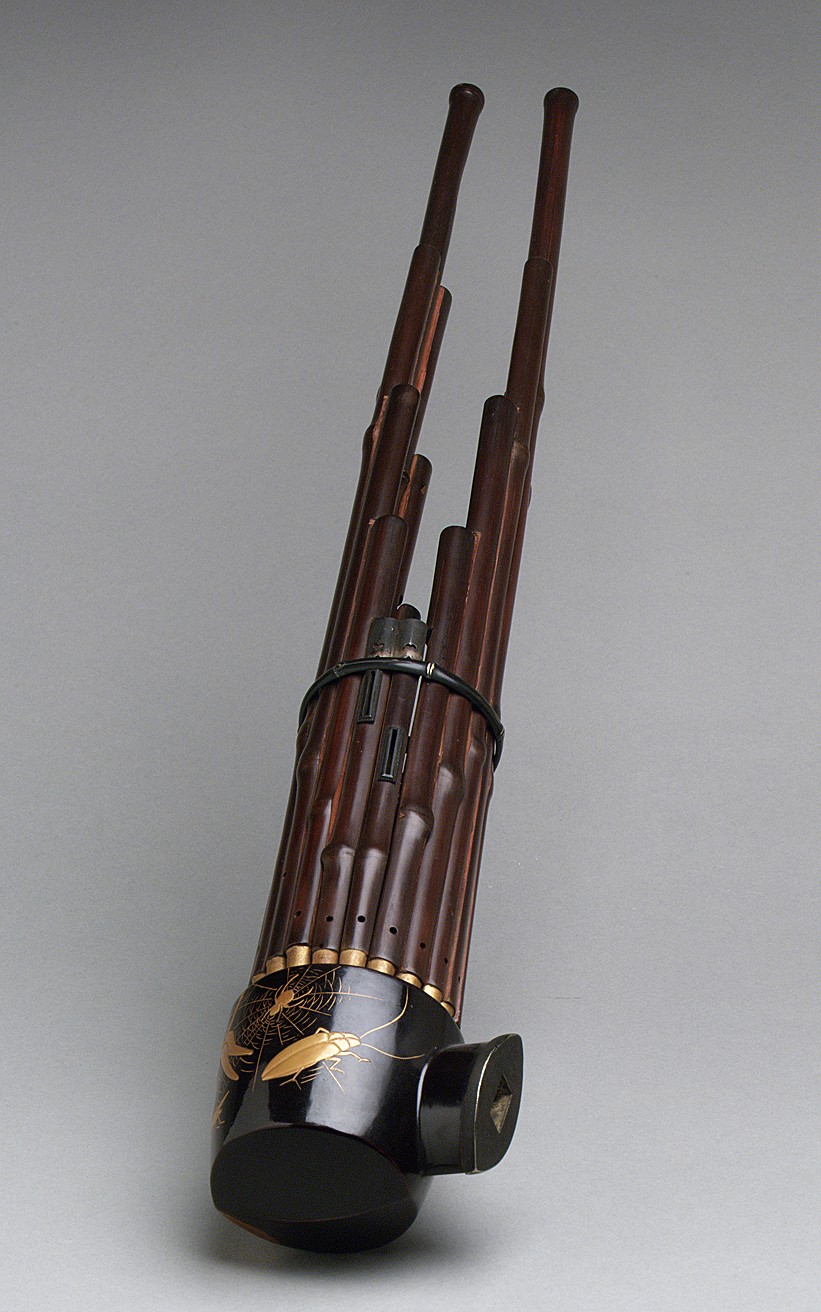
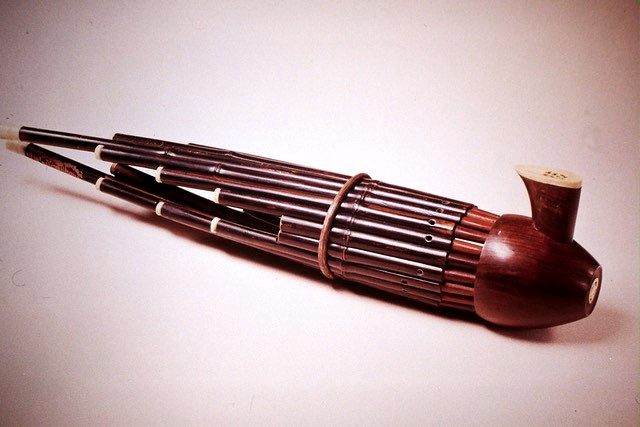
The shō (笙) is the Japanese free-reed mouth organ used principally in gagaku, the Japanese imperial court music whose written repertoire dates from the 7th and 8th centuries. The instrument consists of seventeen slender bamboo pipes set vertically into a small wooden wind chest shaped like a teacup, played by inhaling and exhaling through a single mouthpiece while pressing finger holes that activate individual pipes. The result is a continuous, slowly shifting cluster of five or six simultaneous tones — the aitake chord-clusters that give gagaku its characteristic still, hovering sound.
Wikidata describes the shō as a free-reed musical instrument from Japan and identifies it as the Japanese member of the wider sheng family.
Origin & History
The shō descends directly from the Chinese sheng, which was transmitted to Japan in the 7th and 8th centuries along with the rest of the togaku repertoire imported during the Nara period (710–794). By the formal codification of gagaku at the Japanese imperial court in the 9th century, the shō was already established as one of the three principal wind instruments of the gagaku ensemble (alongside the hichiriki double-reed pipe and the ryūteki transverse flute).
The shō has been preserved in continuous use at the Japanese imperial court for more than 1,200 years through the Gagaku Department of the Imperial Household Agency (Kunaichō Shikibushoku Gakubu) and its Edo-period predecessors. This unbroken transmission ranks the shō among the longest continuously played instruments within any global court music tradition.
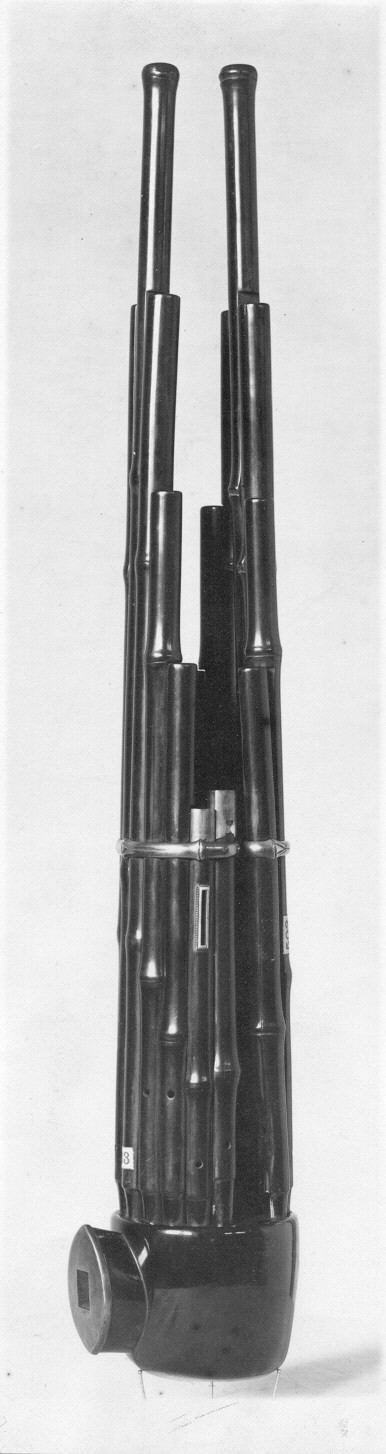
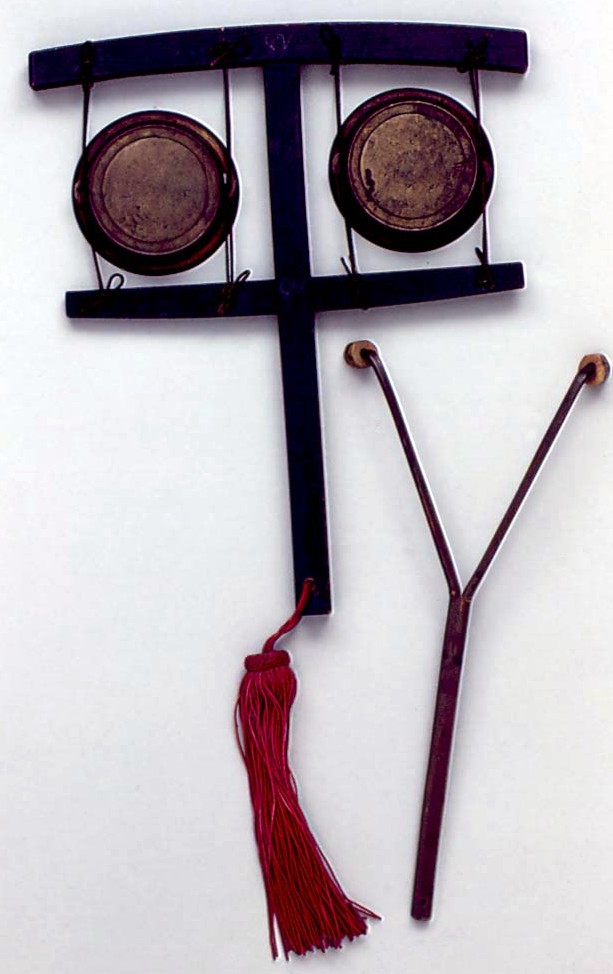
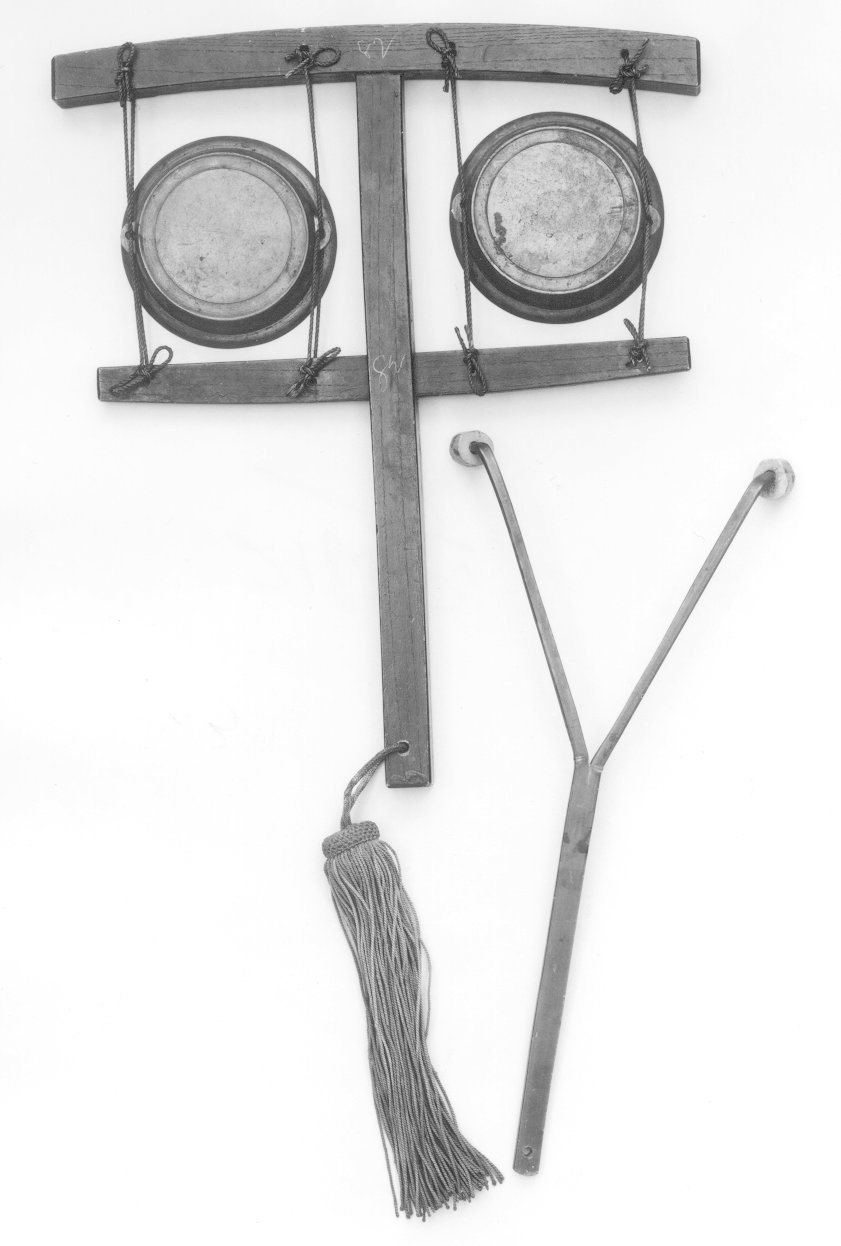
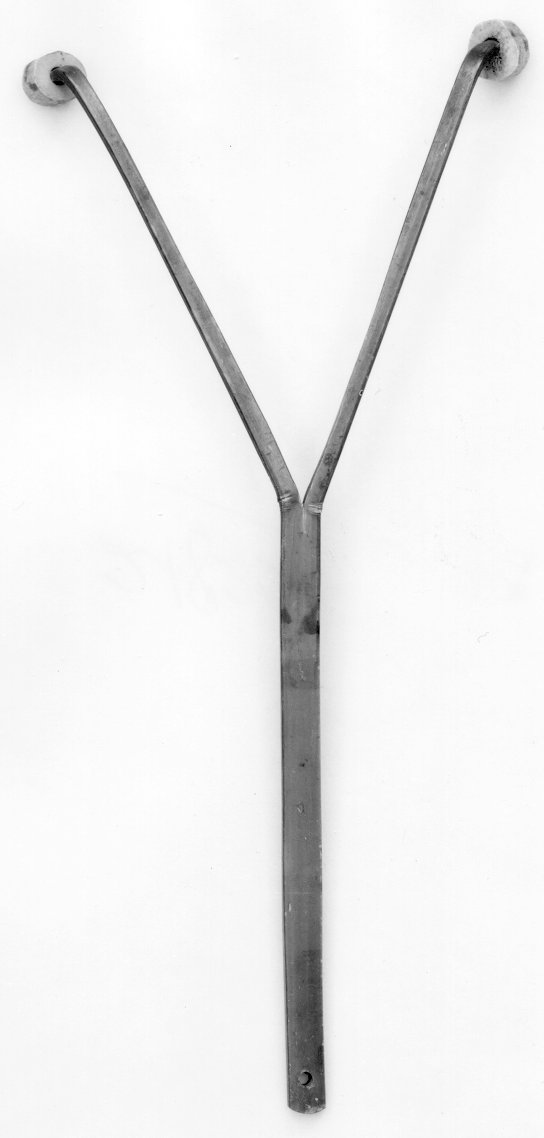
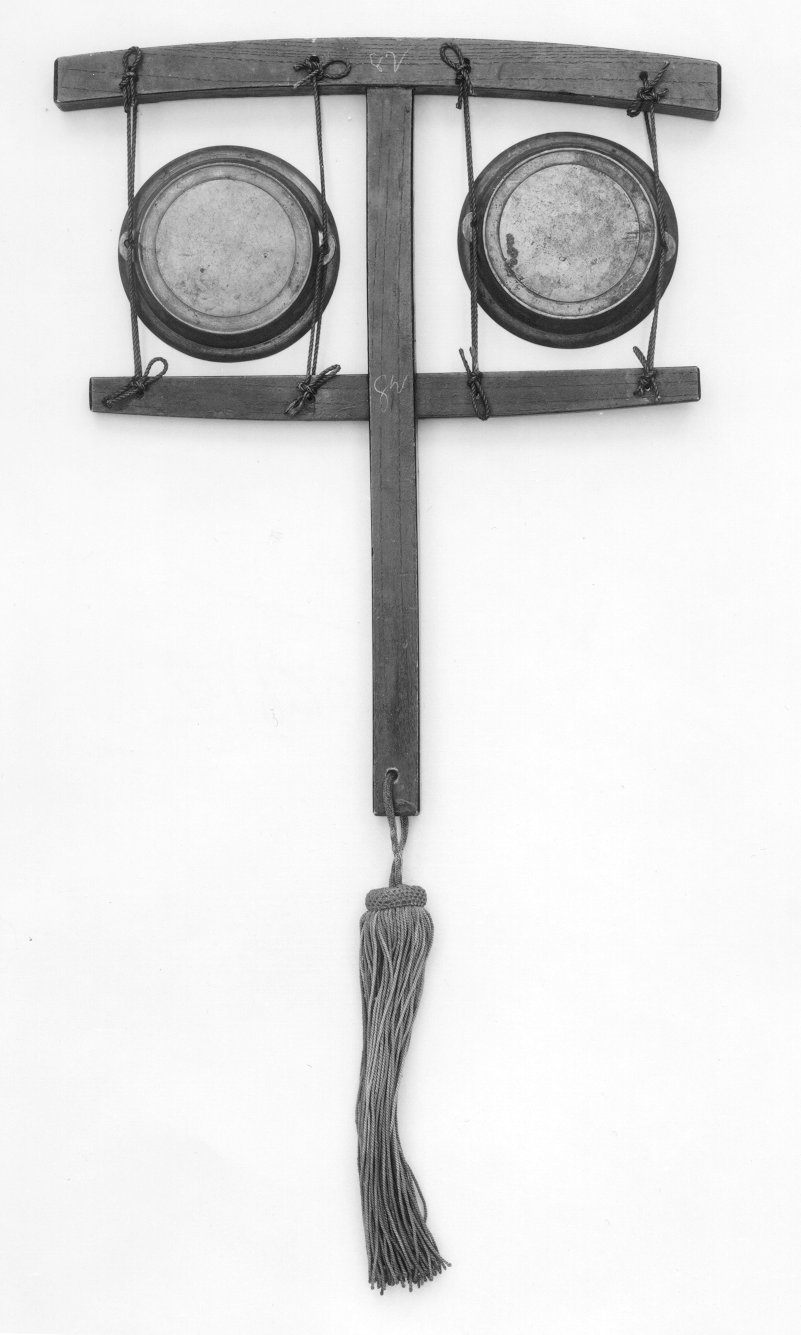
The Metropolitan Museum’s collection holds four Japanese shō. Three are standard 19th-century gagaku instruments: object 502833 (bamboo, wood and metal), object 500657 (wood and metal) and object 500658, which is unusually precisely dated to around 1838. All three are catalogued as Aerophone-Free Reed-mouth organ. A fourth instrument, the Nikko Sho (object 500643), is in fact catalogued as Idiophone-Struck-gong rather than as a free-reed mouth organ — a reminder that the term sho in late-Qing and Meiji-era Japanese is occasionally applied to other temple instruments. All four were donated through the Crosby Brown Collection in 1889.
The 20th century brought the shō into contemporary art music. From the 1960s onward Japanese composers including Tōru Takemitsu, Toshio Hosokawa and Maki Ishii have written substantial chamber and orchestral music for the instrument, and players such as Mayumi Miyata have built international solo careers on it.
Construction & Materials
The shō has seventeen bamboo pipes — fifteen of which sound notes, and two of which are silent (preserved in the design to maintain the visual symmetry of the instrument’s traditional shape). Each pipe is fitted at its base with a small metal free reed, and each has a small finger hole near its base. When the player closes a finger hole and blows or sucks through the central mouthpiece, the air is forced past that pipe’s reed and the reed sounds.
The wind chest, traditionally lacquered wood, is roughly the size and shape of a teacup. The pipes range in height from around 15 to 50 centimetres, set in a circular arrangement that resembles the folded wings of a phoenix — the traditional iconographic association of the instrument.
The shō must be kept warm before and during playing, both to soften the wax that secures the reeds and to prevent moisture from condensing on the reeds and damping their vibration. Players traditionally warm the instrument with a small charcoal brazier (honjyaki) before performance for this reason. This warming routine is one of the most distinctive practical aspects of shō performance.
How It’s Played
The player sits in seiza (formal kneeling position) holding the shō with both hands, the central mouthpiece toward the lips, and breathes both in and out through the same mouthpiece without breaking the sound. The fingers of both hands cover and uncover the small finger holes near the base of the pipes; the closed pipes sound, the open ones do not.
The standard playing technique is the aitake chord-cluster — six-note chords with specific traditional names (kotsu, otsu, gyō and so on) — which form the harmonic vocabulary of gagaku. The player holds each chord for several seconds, breathing in and out through the mouthpiece without interrupting the sound, and changes between chords by lifting and lowering fingers in coordinated patterns.
Cultural Significance
The shō is one of the central voices of gagaku, the imperial Japanese court music that is the oldest continuously performed orchestral music in the world. The Imperial Household Agency Gagaku Department has performed this repertoire continuously for more than a millennium, and the shō has held the same harmonic-cluster role throughout. UNESCO inscribed gagaku on the Representative List of the Intangible Cultural Heritage of Humanity in 2009, with explicit recognition of its instruments and oral transmission.
In contemporary art music the shō has acquired a small but distinguished international repertoire. Tōru Takemitsu’s In an Autumn Garden (1973) and Toshio Hosokawa’s many shō works have brought the instrument’s sustained-cluster sound onto international concert stages. Mayumi Miyata’s collaborations with John Cage, Helmut Lachenmann and many other composers have established the shō as a mainstream contemporary-music instrument.
Notable Examples & Recordings
The MET’s four shō (objects 502833, 500657, 500658, 500643) document late Edo and early Meiji production. The Tokyo National Museum, the Kyoto National Museum and the Imperial Household Agency Music Department in Tokyo all hold further important historical instruments.
For listening:
- Imperial Household Agency Music Department, Gagaku: Ancient Japanese Court Music — the central reference recordings of the gagaku repertoire.
- Mayumi Miyata, The Breathing of the World — solo shō recordings spanning traditional and contemporary repertoire.
- Tōru Takemitsu, In an Autumn Garden — major modern composition featuring the shō.
- Toshio Hosokawa, Cloudscapes — Moon Night — modern chamber music with shō.
Related Instruments
- Sheng – the Chinese mouth organ that is the direct ancestor of the shō.
- – the double-reed pipe that joins the shō in gagaku.
- – the transverse flute that completes the gagaku wind trio.
- – the Lao mouth organ in the same wider Asian free-reed family.
- Harmonica – the modern European pocket free-reed instrument that descends from the Chinese sheng family.
Where to Hear It
The Imperial Household Agency Gagaku Department gives regular public performances at the Imperial Palace in Tokyo and tours internationally. Major Japanese temples — Shitennō-ji in Osaka, Itsukushima Shrine in Hiroshima — host gagaku performances at their festival days. Contemporary shō recitals by Mayumi Miyata and other modern players appear regularly in Tokyo concert halls and on international tour. The Reigakusha gagaku ensemble in Tokyo specialises in both traditional gagaku and contemporary commissions.
- Wikipedia: Shō (instrument)
- The MET: Shō, ca. 1838 (object 500658)
- The MET: Shō, 19th c. (object 502833)
- The MET: Sho, 19th c. (object 500657)
- Wikimedia Commons: Shō (instrument)
Learning Resources
Most shō players in Japan train within the gagaku tradition through long apprenticeships with senior players, often within the Imperial Household Agency or the Reigakusha ensemble. Conservatory study is offered at the Tokyo University of the Arts, where the gagaku programme covers shō, hichiriki and ryūteki. Outside Japan the instrument is increasingly available through online masterclasses by Mayumi Miyata and through workshops at major contemporary-music festivals. New shō by Japanese makers run from approximately 3,000 to 8,000 USD; older instruments occasionally appear on the auction market.
Frequently Asked Questions
Is the shō the same as the Chinese sheng?
The shō descends directly from the Chinese sheng but has developed independently in Japan for over 1,200 years. The Japanese instrument has 17 pipes (15 sounding plus 2 silent for symmetry), uses fixed aitake chord-clusters as its main harmonic vocabulary, and is associated almost entirely with gagaku rather than the broader ensemble role of the modern Chinese sheng.
Why does the shō have to be warmed before playing?
The warming serves two purposes: it softens the wax that holds the metal reeds in place, and it prevents condensed moisture from damping the reeds. Players traditionally warm the instrument using a small charcoal brazier before performance.
What is gagaku?
Gagaku is the Japanese imperial court music whose written repertoire dates from the 7th and 8th centuries. It is the oldest continuously performed orchestral music in the world and was inscribed on the UNESCO Representative List of the Intangible Cultural Heritage of Humanity in 2009.
Are old shō in museums?
Yes. The Metropolitan Museum holds four Japanese shō, including object 500658 dated precisely to around 1838 and object 502833 from the 19th century, all in the Musical Instruments department.
Has any modern composer written for the shō?
Yes. Tōru Takemitsu, Toshio Hosokawa, Maki Ishii, John Cage, Helmut Lachenmann and many others have composed substantial works for the instrument, mostly written for or with the soloist Mayumi Miyata.


