.jpg)
.jpg)
.jpg)
.jpg)

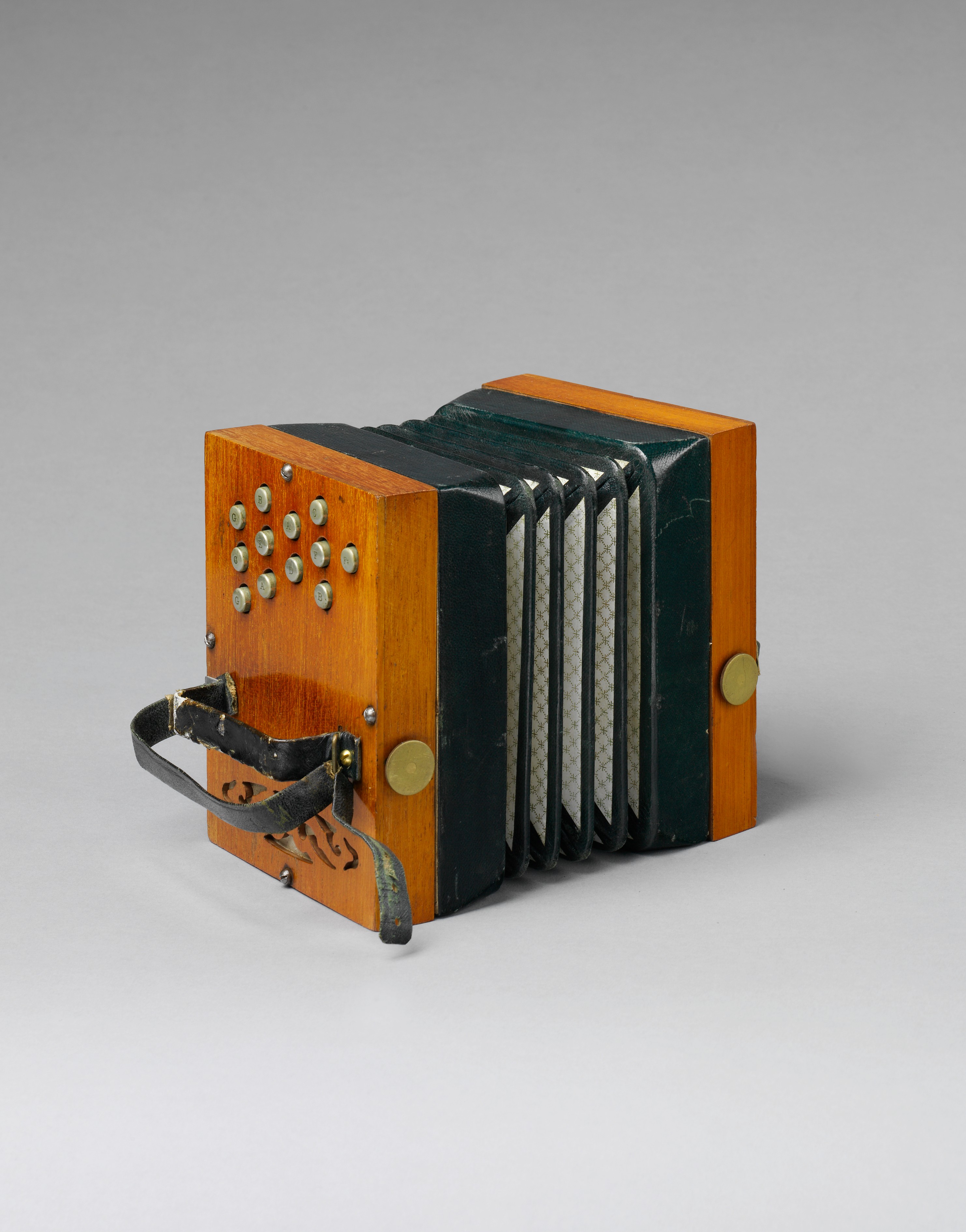

English Concertina
English Concertina
| Category | Wind |
|---|---|
| Country of origin | England (1829) |
| Wikipedia | en.wikipedia.org |
| Wikidata | Q18639200 |
Overview
The English concertina belongs to the hexagonal free-reed bellows family of instruments in which each button produces the same note whether the bellows is pushed or pulled. This is the unisonoric system, in contrast to the bisonoric Anglo concertina in which each button gives a different note in each bellows direction. The two halves of the instrument together carry the full chromatic scale, with successive notes alternating between the right and left hands. Wikidata classifies the instrument as a type of concertina; in the wider Hornbostel-Sachs scheme it sits with the free-reed aerophones alongside the harmonica, accordion and bandoneon.
The instrument was invented by the English physicist Charles Wheatstone in 1829 and is the original concertina design — the bisonoric Anglo and the duet concertinas all came later. The English concertina remained the standard concertina of Victorian salon and parlour music throughout the second half of the 19th century and survives today as a serious folk and concert instrument.
Origin & History
Charles Wheatstone of London — better known to the wider world as the inventor of the Wheatstone bridge in electrical engineering — patented the English concertina in 1829 (UK patent number 5803). His design grew out of his interest in the acoustics of free reeds and was first marketed by his family firm Wheatstone & Co., founded earlier as a music shop on Conduit Street and later relocated to West Street in central London. By the late 1830s the instrument was an established product line; by the 1850s it was a Victorian craze.
The Metropolitan Museum of Art’s collection includes two important early examples. Object 503682 is a Concertina made in Britain between 1831 and 1837 — that is, in the first decade of the instrument’s commercial life and quite possibly from Wheatstone’s own workshop — built of rosewood, nickel-silver, leather, paper, ivory and tortoiseshell, with a mahogany case. Object 503683 is a slightly later British concertina from 1855–60, by which point the larger Lachenal & Co. firm (founded by a former Wheatstone employee) had become the dominant manufacturer. The two specimens together document the English concertina across its first three decades, from prototype through to mass production.
Three concertina lineages emerged from the English concertina firms in the second half of the 19th century: the original Wheatstone English concertina; the German-import Anglo concertina (taken up by English makers Lachenal, Jones and Jeffries); and the duet concertinas (the Crane, MacCann and Hayden systems) that combined chromatic playing with split-hand orchestration. By 1900 the Wheatstone and Lachenal firms together were employing several hundred workers in west and central London making concertinas for the global Victorian middle class.
The instrument went through a mid-20th-century near-collapse as accordions, pianos and gramophones absorbed its market. A folk-revival recovery in England — led by Alf Edwards, then by Alistair Anderson and Dave Townsend in the 1960s and 1970s — restored the English concertina to active use as a folk and chamber instrument. Modern concert players including Simon Thoumire, Rob Harbron and Cohen Braithwaite-Kilcoyne have extended its repertoire well into contemporary jazz and chamber music.
Construction & Materials
A standard 48-button treble English concertina is hexagonal, around 16 centimetres across the flat sides, and weighs about 1.2 kilograms. The end-plates are wood (rosewood, mahogany or ebony) carved or fretted with sound-grilles and pierced to carry the buttons. The bellows is multi-fold leather (typically 6 or 7 folds) bound with bookcloth and paper. The MET examples — both with rosewood or mahogany cases and the inner reedwork of brass and steel — are characteristic of the high-quality 19th-century instruments.
Inside each end-plate, a wooden reed pan carries one steel reed per button mounted in a small brass shoe. Each button uses a single reed (not paired as in the Anglo), and a leather valve closes off the unused side of the air channel so that the same note sounds on both press and draw. Concert-grade instruments use individually filed steel reeds; cheaper student instruments use accordion-style clamped reeds.
The standard layout is treble (lowest note G3); larger formats include the baritone, the bass, the contrabass and the small piccolo treble. A 48-button treble covers four octaves chromatically. The two ends are held with thumb-straps and a small finger-rest plate, leaving four fingers free on each hand to play the buttons.
How It’s Played
The player holds one end of the instrument in each hand, thumbs through the leather thumb-straps and the little fingers resting on a small support plate. The four playing fingers of each hand work the buttons. Bellows technique is independent of melody — the player decides the bellows direction freely to articulate phrasing, dynamics and accent.
The chromatic notes alternate between hands: from low to high, the C, E and G of the scale fall on the left hand, the D, F and A on the right, and so on through the four octaves. This split allows a player to alternate hands rapidly through scale passages, which gives the English concertina its characteristic fluent fast-passage capability and is one of the principal arguments for its use in classical and chamber repertoire.
Cultural Significance
Across Victorian Britain the instrument was the most fashionable home keyboard-equivalent of the chromatic free-reed family and a fixture of middle-class music-making. Soloists including Richard Blagrove and the Italian-born Giulio Regondi played it on concert platforms across Europe; Regondi’s two surviving concertina concertos remain landmarks of the original concert repertoire. The instrument also entered the Salvation Army, where it became the standard chromatic melody instrument for street and outdoor mission work.
In the modern English folk revival the instrument has settled into a steady role as a melody and chamber instrument — Alistair Anderson’s Northumbrian recordings, Rob Harbron’s collaborations with Emma Reid and others, and the work of Simon Thoumire in Scottish music together represent the contemporary instrument’s range. The English concertina remains less identified with Irish dance music than the Anglo, although a small but growing number of Irish players use it for slow airs and song accompaniment.
Notable Examples & Recordings
- Alistair Anderson, Concertina Workshop and decades of Northumbrian and English folk recordings.
- Simon Thoumire, The Big Day In — Scottish concertina virtuoso work.
- Rob Harbron, recordings with Emma Reid and the Songs from the Floodplain ensemble.
- Giulio Regondi, two surviving concertina concertos (1840s) — the high point of original concert repertoire.
- The Metropolitan Museum’s two specimens (objects 503682 and 503683) bracket the first three decades of the instrument’s commercial life.
Related Instruments
- Concertina – the wider family.
- Anglo concertina – the bisonoric concertina type that became the standard for Irish music.
- – the third concertina type, with melody and accompaniment split between hands.
- Bandoneon – the German free-reed instrument that became Argentine.
- Harmonica – the small mouth-blown free-reed cousin invented in roughly the same decade.
Where to Hear It
Concertinas at Witney (Oxfordshire) is the principal annual English concertina festival. The International Concertina Association’s events run throughout the year. The Sage Gateshead in northeast England is the home base of the Folkworks programme that has trained many contemporary English concertina players. Recordings appear on labels including Topic, Fellside, Wild Goose, Park and the Sound Recordings of the International Concertina Association catalogue.
- Wikipedia: English concertina
- Wikidata: English concertina (Q18639200)
- The MET: Concertina (object 503682)
- The MET: Concertina (object 503683)
- Wikimedia Commons: English concertinas
Learning Resources
The International Concertina Association (UK) is the principal English-language teaching and community body and publishes Concertina World magazine. Roger Watson, Dave Townsend, and the Sage Gateshead Folkworks summer schools are leading teaching venues. Method books include Roger Watson’s Handbook for English Concertina, Alistair Anderson’s Concertina Workshop, and Allan Atlas’s monograph on Wheatstone’s instrument in 19th-century Britain, published by Oxford UP, for historical background. A serviceable student English concertina (Jack, Jackie or the Asian-built Rochelle equivalent) starts at around 500 USD; vintage Wheatstone or Lachenal treble instruments in restored playing condition begin at around 2,500 USD; concert-grade modern instruments by Wakker, Morse or Suttner-Cohen run from 6,000 USD.
Frequently Asked Questions
Who invented the English concertina?
The English physicist Charles Wheatstone, who patented the design in London in 1829.
What is the difference between English and Anglo concertinas?
The English concertina is unisonoric — each button produces the same note on push and pull, and the chromatic scale alternates between hands. The Anglo is bisonoric — each button produces a different note in each direction.
How old is the oldest English concertina?
Wheatstone began commercial production in 1829, and a small number of pre-1840 specimens survive in museum collections including the Metropolitan Museum of Art (object 503682, 1831–37) and the Wheatstone archive at the Horniman Museum in London.
What kind of music is the English concertina used for?
Original Victorian salon and chamber music; the surviving Regondi concertos; English and Scottish folk music; Salvation Army and outreach music; and modern contemporary chamber, jazz and crossover repertoire.
Are vintage Wheatstone and Lachenal concertinas still playable?
Yes — many 19th-century instruments restored by specialist workshops play to a high standard. Restored vintage Wheatstones in particular are sought after by concert-level players and command prices comparable to modern handmade instruments.


