.jpg)


Quena
kena / qina
| Category | Wind |
|---|---|
| Country of origin | Andean South America |
| Classification | type of musical instrument |
| Wikipedia | en.wikipedia.org |
| Wikidata | Q841005 |
Listen
Audio: LPMR, PD / via Internet Archive
Audio: Christian Reyes Ortiz, CC BY / via Internet Archive

Overview
The quena (also spelled kena) is a notched end-blown bamboo flute of the Andean highlands of South America. The standard instrument is a single piece of bamboo around 38 centimetres long with six finger holes on the front, one thumbhole on the back, and a notched mouthpiece cut into the top of the tube. The player blows obliquely across the notch to set up the standing wave, producing a soft, breathy sound that has been the principal melodic wind instrument of the Quechua and Aymara peoples for at least two thousand years.
Wikidata describes the quena as the “traditional flute of the Andes,” classed within the open-flute-with-internal-duct family. The MET specimens are catalogued as Aerophone-Blow Hole-end-blown flute (vertical).
Origin & History
End-blown notched flutes are documented in the central Andes from at least the early first millennium CE through pre-Inca cultures including the Chavín, Paracas, Nazca, Moche and Wari. Surviving instruments from this period are made of a remarkable variety of materials — bone, ceramic, copper and stone — and many of them are notched flutes structurally identical to the modern bamboo quena.
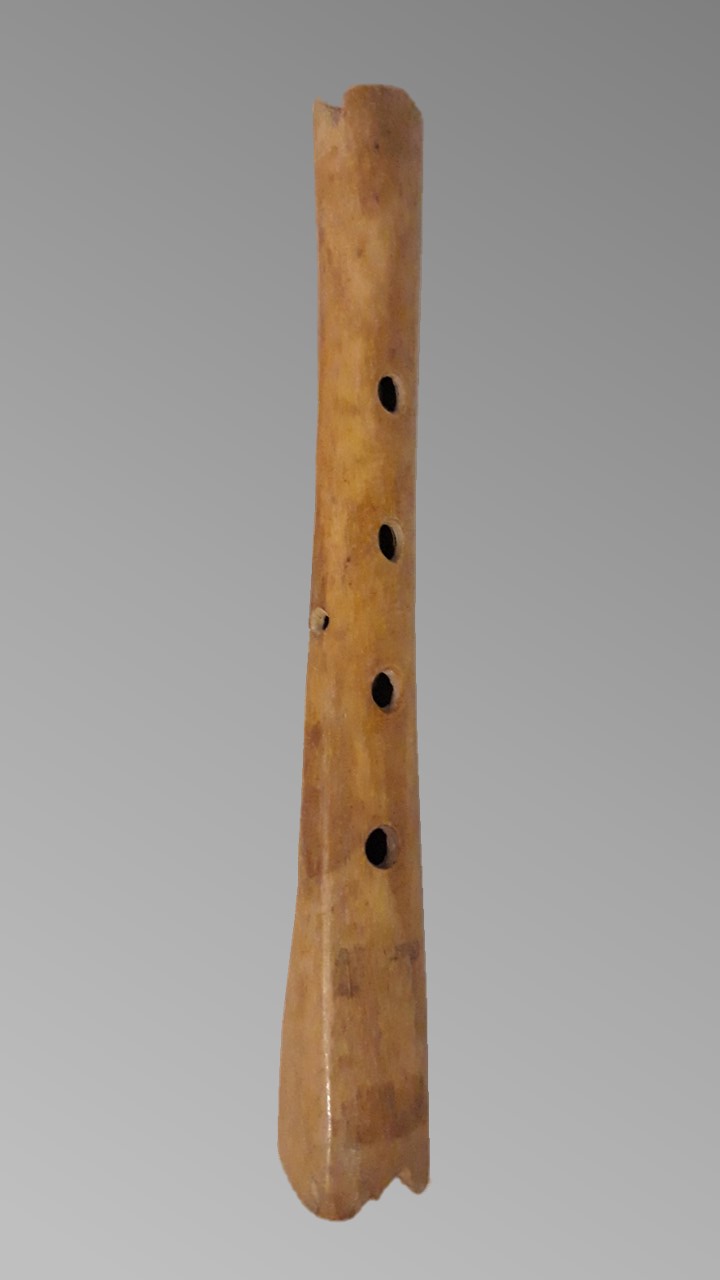
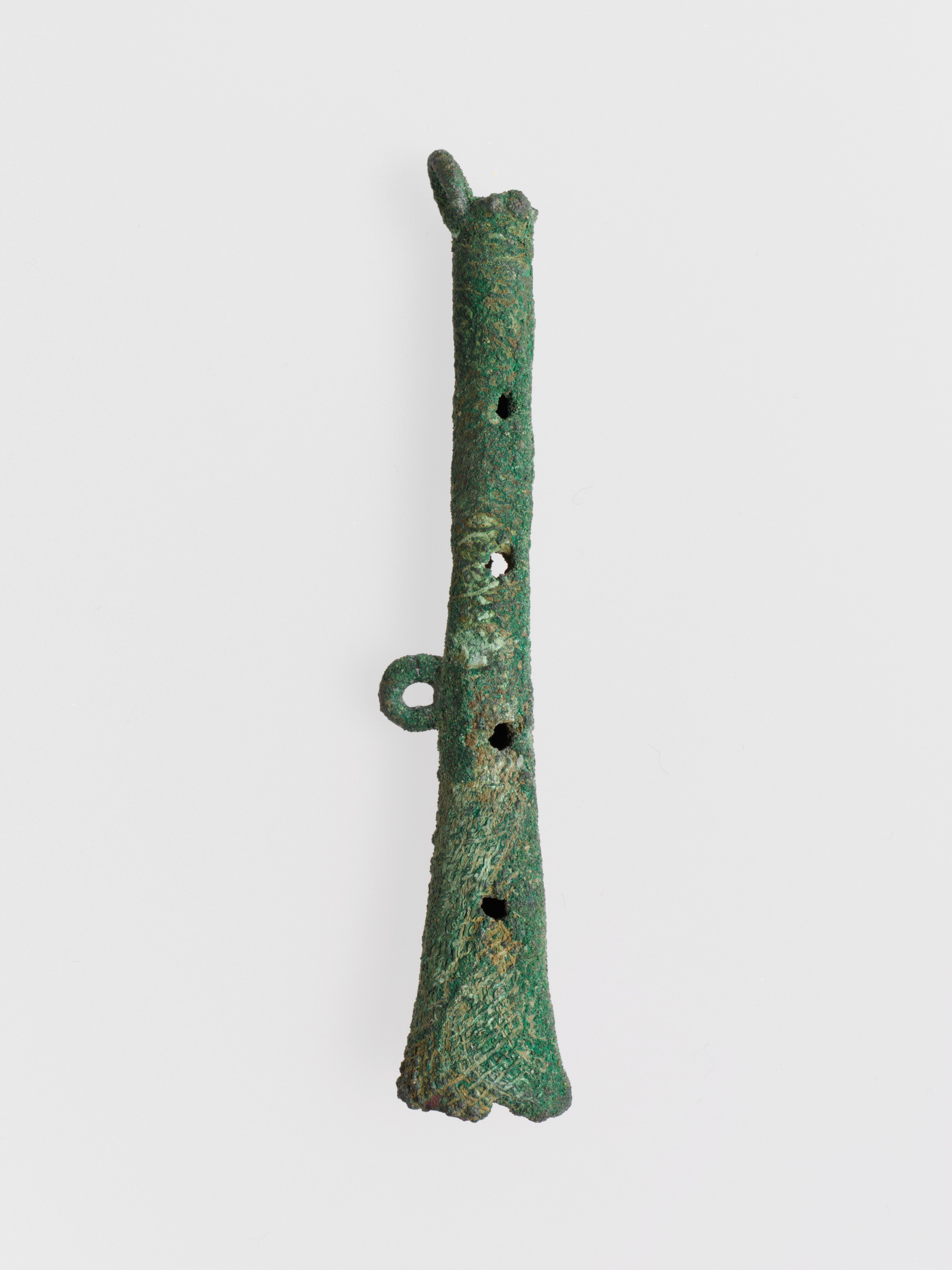
The Metropolitan Museum’s collection holds two quena that span this very wide chronological range. The earlier of the two — and one of the most remarkable musical instruments in any museum collection — is a Moche Quena (Kena) (object 503192) made of copper and dated to 200–400 CE. Acquired through the Rogers Fund in 1981, it represents the pre-Inca Moche civilisation of the northern Peruvian coast and is one of the very few pre-Hispanic South American wind instruments in any major American museum collection. A more recent Native American (Peruvian) quena (object 501881) of the 19th century is built of bone and wax or rubber and was donated through the Crosby Brown Collection in 1889. Together the two specimens document continuity of design across nearly 1,800 years.
The Inca civilisation (15th–16th centuries CE) inherited and continued the notched-flute tradition, and the quena was widely used across the Inca empire from northern Ecuador through Peru and Bolivia to northern Chile and northwestern Argentina. After the Spanish conquest the instrument continued in indigenous and mestizo musical practice, and it remains today one of the principal living musical traditions of Andean South America.
The 1960s and 70s brought the quena to international attention through the nueva canción movement and through international Andean folk groups such as Inti-Illimani, Quilapayún and Los Calchakis. The internationally famous Simon and Garfunkel arrangement of El Cóndor Pasa (1970) used a quena as one of its central melodic voices, and the instrument has remained part of the international folk-music vocabulary ever since.
Construction & Materials
A standard modern quena is around 38 centimetres long and is made of a single piece of bamboo, with six finger holes on the front, one thumbhole on the back, and a notched mouthpiece — a small U-shaped or V-shaped notch — cut into the top of the tube. The bamboo species varies by region, with the Bolivian tacuara and the Peruvian huairuro both widely used.
Pre-Hispanic and early-colonial quena were also made in a remarkable variety of materials — most strikingly the MET’s Moche copper specimen (object 503192), which is a hammered metal version of the same design. Bone quena (such as MET 501881) and ceramic quena are also documented archaeologically and ethnographically.
The full chromatic two-and-a-half-octave range is achieved through cross-fingerings and overblowing — an unusual achievement for a flute with only seven holes and no keys.
How It’s Played
The player holds the quena vertically with the notched mouthpiece resting against the lower lip and the tube angled slightly away from the body. Breath is directed obliquely across the notch, splitting against the edge to set up the standing wave. The right thumb supports the instrument; the left thumb covers the back hole; the four fingers of both hands cover the front holes.
The technique relies almost entirely on breath control and embouchure — there are no keys to drive, no reed to manage, and dynamic and tonal expression come from the player’s air pressure, mouth shape and finger placement. Andean playing technique includes wide vibrato (temblor), slides between adjacent pitches (deslizamiento), grace notes (morchina) and the characteristic high-register attack that defines the modal melodies of huayno and yaraví dance music.
Two-octave-plus range is reached by overblowing, which the quena does smoothly because of its end-blown notched-mouthpiece construction.
Cultural Significance
The quena is one of the most widely recognisable musical instruments of Latin America and the central traditional wind instrument of the Andean highlands. Its repertoire — huayno, yaraví, carnaval, taquirari, kena-kena — covers thousands of years of continuous Andean musical practice and connects modern Andean communities to their pre-Hispanic ancestors in a uniquely direct way.
In modern South American culture the quena occupies a particular position as a symbol of indigenous Andean identity. The 1960s nueva canción movement, particularly in Chile under Allende and in Argentina under the Perón years, used the quena as one of its central sonic markers, and the instrument has retained this politically resonant association ever since. International groups such as Inti-Illimani and Quilapayún have carried Andean music — and the quena — to audiences worldwide for more than fifty years.
The Simon and Garfunkel arrangement of the Daniel Alomía Robles composition El Cóndor Pasa — itself based on traditional Andean melodies — brought the quena’s distinctive sound to global popular awareness in 1970, and the instrument has appeared widely in film soundtracks and world-music recordings ever since.
Notable Examples & Recordings
The MET’s two specimens (objects 503192 and 501881) document the quena across nearly two thousand years of continuous design.
For listening:
- Inti-Illimani, La nueva canción chilena — central Andean folk recordings featuring quena.
- Los Calchakis, El Cóndor Pasa — French-based Argentinian Andean group whose 1965 recording inspired the Simon and Garfunkel version.
- Facio Santillan, Quena Andina — modern Argentinian solo quena player.
- Daniel Alomía Robles original recordings — historical Peruvian recordings of the composer of El Cóndor Pasa.
Related Instruments
- Pan Flute – the Andean zampoña and siku pan-pipes, often played alongside the quena in Andean ensembles.
- Charango – the small Andean string instrument that frequently accompanies the quena.
- – the Argentine bass drum that anchors much Andean folk music.
- Xiao – the Chinese end-blown notched bamboo flute, a parallel global tradition.
- Shakuhachi – the Japanese end-blown bamboo flute.
Where to Hear It
The annual Carnaval de Oruro in Bolivia (every February-March, inscribed by UNESCO in 2001), the Inti Raymi festival in Cusco every June, and the Virgen de la Candelaria festival in Puno every February-March are the largest annual Andean festivals featuring quena playing in mass form. Concert tours by Inti-Illimani, Quilapayún, the Sucre-based Bolivian groups and many others bring the quena to international audiences continuously. The South American Music Centre in Buenos Aires and the Andean cultural centres in Cusco, La Paz and Quito offer regular performance and instruction.
- Wikipedia: Quena
- The MET: Quena (Kena), Moche 200-400 CE (object 503192)
- The MET: Quena, Native American (Peruvian) 19th c. (object 501881)
- Wikimedia Commons: Quena
Learning Resources
The quena is one of the most accessible end-blown flutes for beginners — it requires no reed, no key system, and produces a pleasing tone within the first hour of practice. Standard tutor materials include the Spanish-language method books published in Lima, La Paz and Buenos Aires, and increasingly available English-language online instruction. Conservatory-level study is offered at the National Conservatory of Music in Lima, the Bolivian National Conservatory in La Paz, and the music department of the National University of Cuyo in Argentina. New bamboo quenas by Andean makers run from approximately 30 to 150 USD; high-end professional instruments can reach 300 USD.
Frequently Asked Questions
How does the quena produce its sound?
The player blows obliquely across the U-shaped or V-shaped notch cut into the top of the tube, splitting the breath stream against the opposite edge of the notch to set up the standing wave. The same notched-mouthpiece principle is used by the Chinese xiao and the Japanese shakuhachi.
How old is the quena?
End-blown notched flutes are documented in the Andes from at least the early first millennium CE. The Metropolitan Museum’s Moche copper quena (object 503192) is dated to 200-400 CE, pushing the documented history of the instrument back nearly 1,800 years.
What is the difference between a quena and a pan flute?
A quena is a single tube with finger holes; one player covers and uncovers the holes to produce different pitches. A pan flute (zampoña or siku in the Andes) consists of multiple tubes of different lengths bound together, with each tube producing a single fixed pitch and the player moving the lips along the row to select the note.
Are old quena in museums?
Yes. The Metropolitan Museum holds two: a remarkable Moche copper quena from 200-400 CE (object 503192), and a 19th-century Peruvian bone quena (object 501881), both in the Musical Instruments department.
What music is the quena used for?
The quena is the central traditional wind instrument of Andean folk music, used in huayno, yaraví, carnaval, taquirari and many other regional dance and ceremonial genres. In modern international concert music it appears in nueva canción, in Andean folk arrangements, and in world-music ensembles. The Simon and Garfunkel arrangement of El Cóndor Pasa (1970) featured quena in its central melody.
Where is the quena played outside the Andes?
The quena is played in the Andean diaspora communities worldwide and increasingly in international world-music and folk ensembles. International groups such as Inti-Illimani and Quilapayún have toured Andean music continuously since the 1960s, and the quena now has a small but established international community of non-Andean players.


