Nai
Nāy / ney
| Category | Aerophone |
|---|---|
| Country of origin | Middle East (ancient) |
| Classification | Wikimedia disambiguation page |
| Wikipedia | en.wikipedia.org |
| Wikidata | Q252396 |
Listen
Audio: Various Artists, CC BY / via Internet Archive
Overview
The nai — also spelled nāy and, in the closely related Turkish and Persian forms, ney — is an end-blown reed flute used as a principal melody instrument in Arabic, Turkish, Persian, Kurdish, and wider Middle Eastern classical and devotional music. It is among the longest-surviving instruments still actively played, with documented presence in Egyptian tomb finds and wall paintings reaching back at least 4,500 years.
Wikidata catalogues the entry as a disambiguation page covering several related instruments; in practical regional usage nai most commonly means the Arab oblique-blown reed flute, ney the Turkish and Persian instruments, and nāy the older or more formal spelling used in scholarly writing. All are variants of the same basic single-reed-tube design.
Origin & History
End-blown reed flutes appear in the archaeological record of the wider Middle East from at least the 3rd millennium BCE — examples have been excavated at the Royal Cemetery of Ur (modern Iraq) and depicted in the wall art of Old Kingdom Egyptian tombs. The instrument’s design is so simple — a single hollow cane tube with finger-holes — that it almost certainly developed independently in several places.
By the medieval Islamic period the nay had become the standard concert flute of the wider Persian and Arabic musical worlds. It is referenced extensively in 9th- and 10th-century Arabic theoretical writing (Al-Farabi, Al-Kindi). The Turkish ney is the central instrument of the Mevlevi (whirling dervish) Sufi order, founded by the followers of the 13th-century Persian poet Rumi; Rumi’s Masnavi opens with the famous lines on the ney mourning its separation from the reed bed, and that opening fixes the instrument’s symbolic place in Sufi devotional thought.
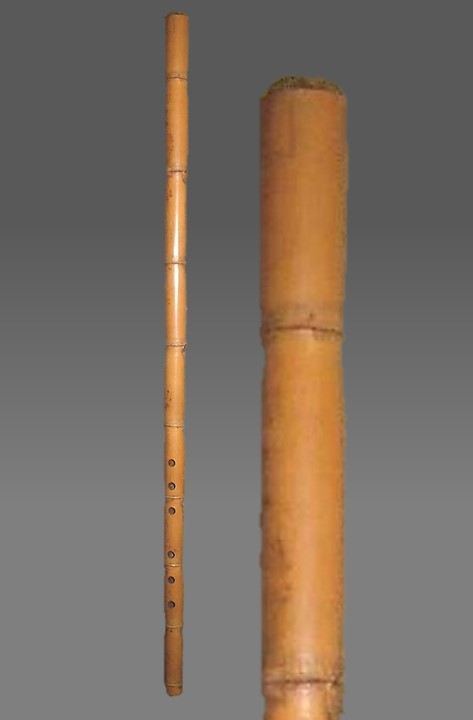
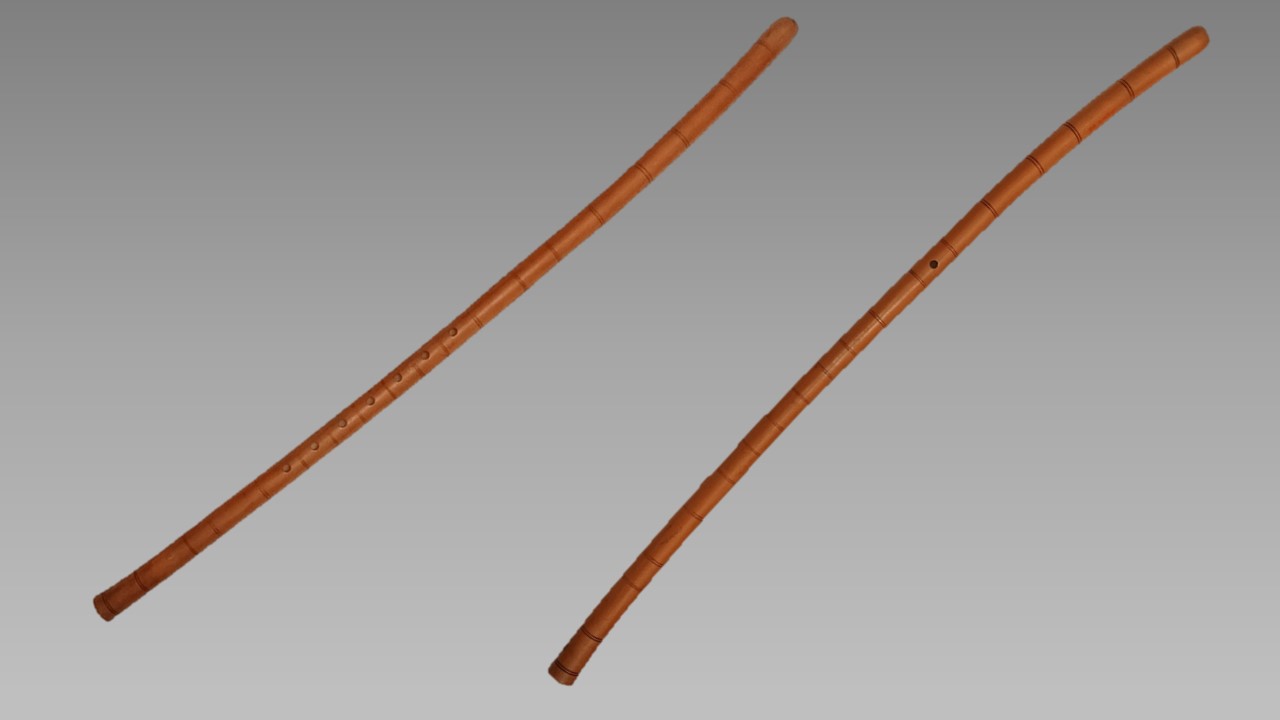
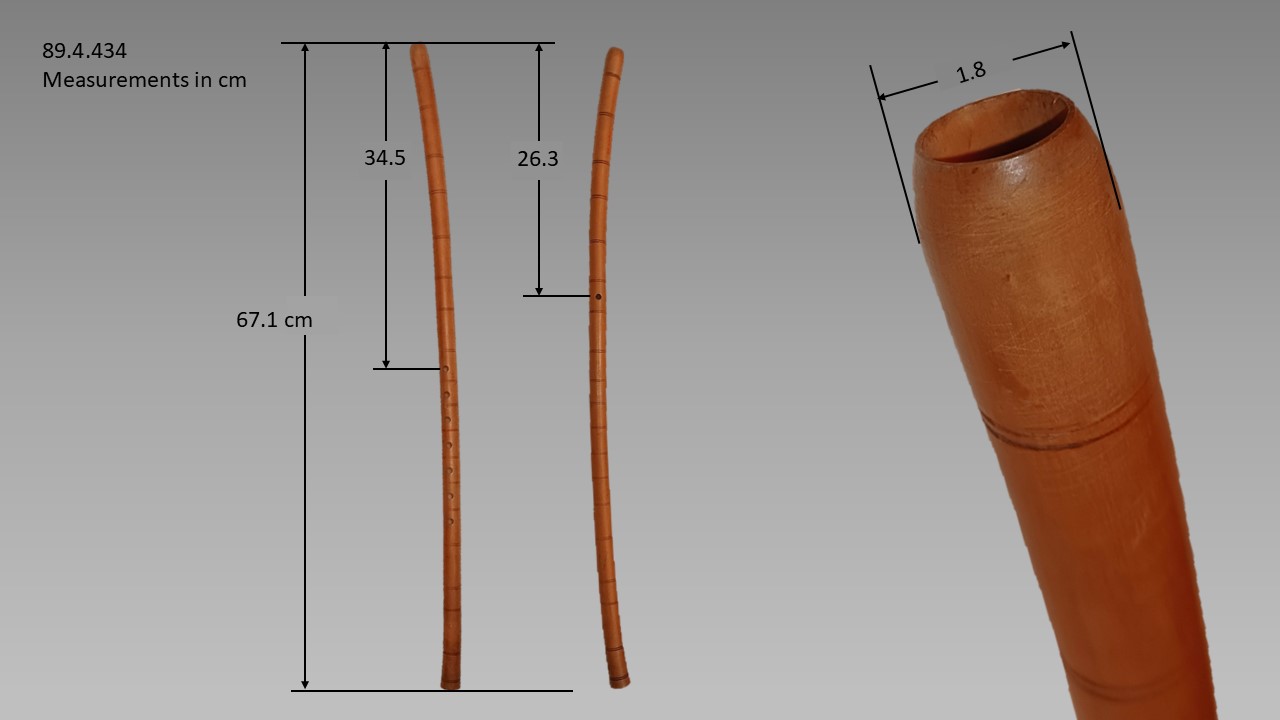
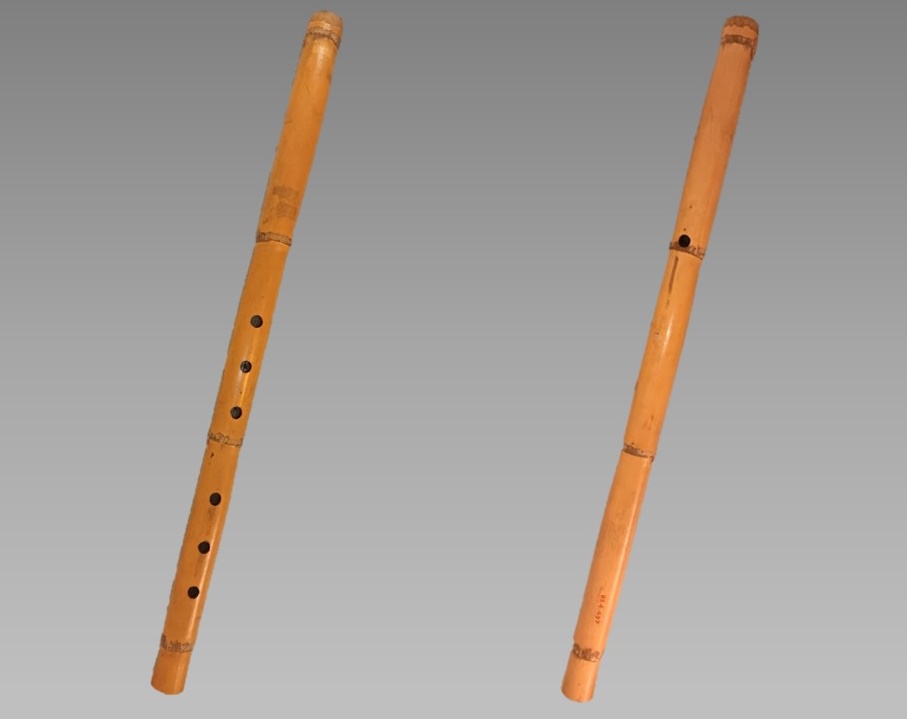
The MET collection documents the late-19th-century instrument across four cultural regions. Object 501050 is a Syrian reed nāy of the 19th century. Object 501052 is a late-19th-century Syrian wooden nay. Object 501055 is a late-19th-century Turkish or Arabic bamboo nay. Object 504821 is a late-19th-century Persian ney assembled from reed, metal, and hide. The material variation across these four specimens — reed, wood, bamboo, reed-and-metal-and-hide — illustrates a working tradition of regional adaptation around a shared design.
Construction & Materials
A standard nai is a single piece of giant cane (Arundo donax), traditionally cut from a reed bed in late autumn after the cane has fully dried on the stalk. The instrument has six front finger holes and one rear thumb hole — fewer than most Western flutes, but extended by sophisticated half-holing and embouchure-angle technique. Length varies from about 45 cm to 90 cm, defining the seven traditional sizes (each named for the relative pitch class) of the Persian ney family.
The Persian ney is distinguished by a metal mouthpiece (a brass or copper ring set into the upper end) and is played with the mouthpiece placed between the upper and lower front teeth, with the air directed by the tongue across the inside surface of the upper teeth. The Arabic and Turkish nai is played without this dental mouthpiece; the player blows obliquely across a beveled rim at the upper end. The two embouchure techniques are sufficiently different that few players cross between them.
How It’s Played
The nai is held angled outward and downward from the player’s face. The right and left hand cover the finger holes; the mouth supplies a narrow, fast airstream across the rim or through the metal mouthpiece.
Standard playing range covers about two and a half octaves. Players use breath dynamics, half-holing, and small embouchure shifts to produce the microtonal intervals (quarter tones and other non-tempered intervals) that the maqam and dastgah systems of Arabic, Turkish, and Persian music require. The tone is breathy at low dynamics and clear at higher dynamics — the breathiness is treated as a desired expressive feature, not a flaw, particularly in the Sufi tradition.
Cultural Significance
The Persian ney is the central instrument of the Mevlevi Sufi sema ceremony — the so-called whirling-dervish ritual founded in 13th-century Konya by the followers of Rumi. The instrument’s symbolic role as the voice of the soul separated from God, fixed by the opening of Rumi’s Masnavi, has remained continuous from the medieval period to the present.
In Arabic classical music the nai is one of the four standard takht (chamber-ensemble) instruments alongside the oud, qanun, and riqq. Egyptian, Syrian, Lebanese, and Iraqi classical-music broadcasts of the 20th century — Umm Kulthum’s orchestra, the Asmahan recordings, the Cairo and Damascus radio orchestras — have given the nai a continuous mass-audience presence.
In Turkish classical and sema music the same instrument is the central wind voice. Niyazi Sayın (b. 1927) is the most internationally recognised modern Turkish neyzen; Kudsi Erguner has been the central international export of the tradition since the 1970s. In Iran, Hassan Kassai (1928-2012) and Hossein Omoumi are the principal modern reference figures.
Notable Examples & Recordings
- Hossein Omoumi, The Persian Ney (Nimbus, 1988) — definitive recital recording in the Persian radif tradition.
- Kudsi Erguner, The Mystic Flutes of Sufi (Arc Music) — Turkish ney in Mevlevi context.
- Hassan Kassai’s All India Radio recordings and Iranian National Radio archives.
- Niyazi Sayın’s complete recorded taksim (improvisation) corpus.
- Anouar Brahem’s Astrakan Café (ECM, 2000) — modern jazz collaboration with prominent Arab nai voice.
Related Instruments
- Ney (Turkish ney) — the Turkish form covered in detail.
- Kaval — the Bulgarian and Turkish folk end-blown flute.
- Shakuhachi — the Japanese end-blown bamboo flute used in Zen practice; conceptually parallel devotional flute.
- Quena — the Andean notched-end vertical flute.
- Bansuri — the North Indian transverse bamboo flute.
- Suling — the Indonesian end-blown bamboo flute with palm-leaf ring.
- Danso — the Korean end-blown bamboo flute.
Where to Hear It
In Istanbul the Galata Mevlevihanesi and the various Mevlevi Sufi orders perform regular sema ceremonies open to the public. In Cairo and Damascus the radio-orchestra archives provide deep historical reference. International festival venues with reliable nai programming include the Festival of World Sacred Music in Fez, Morocco; the Istanbul Music Festival; and the WOMAD circuit. Recordings on labels such as Nimbus, ECM, Network, and Long Distance.
- Wikipedia: Ney
- Wikipedia: Nay
- Wikidata: Nai (Q252396)
- DBpedia: Ney
- MET Object 501050 (Syrian nāy, 19th c.)
- MET Object 501055 (Turkish or Arabic nay, late 19th c.)
- MET Object 504821 (Persian ney, late 19th c.)
Learning Resources
A starter Persian or Arabic nai costs 50 to 200 USD from specialist makers in Cairo, Istanbul, Damascus, or online via the Maqam World shop and similar specialist vendors. Professional handmade nais by named makers (Hammouda Ali in Egypt, Bayram Bilgin in Turkey, masters of the Esfahan school in Iran) run 400 to 1,500 USD. Pedagogically, in-person teaching is dominant — the embouchure is genuinely difficult to teach in writing. Hossein Omoumi’s online masterclass series and the published Sayın method books are useful supplementary resources.
Frequently Asked Questions
Is the nai the same as the ney?
They are regional names and slightly different forms of the same end-blown reed-flute family. Arabic nāy, Turkish and Persian ney. The Persian instrument has a distinctive metal mouthpiece played between the teeth.
How old is the nai?
A minimum of 4,500 years in the Mesopotamian and Egyptian archaeological record. The modern Arabic, Turkish, and Persian variants have over a thousand years of continuous written documentation.
Why does the nai sound breathy?
Because the embouchure deliberately allows some uncoupled air to pass without entering the tube. The breathy timbre is treated as an expressive feature, particularly in Sufi devotional contexts.
Is the Persian ney difficult to learn?
The dental embouchure is widely regarded as the hardest single technical hurdle in the world flute family. Most players need a year or more of regular practice before producing a stable tone.
What music is the nai used in?
Arabic, Turkish, Persian, Kurdish, and wider Middle Eastern classical music; Sufi devotional music (especially the Mevlevi tradition); modern jazz, world music, and film-score collaborations.

