.jpg)
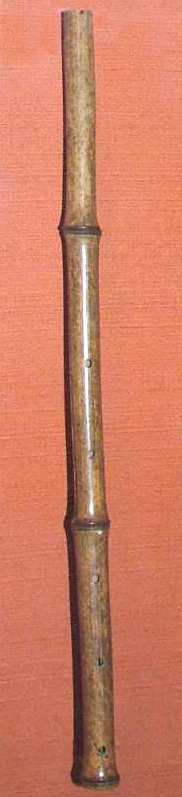

Danso
단소 (danso)
| Category | Wind |
|---|---|
| Country of origin | Korea |
| Wikipedia | en.wikipedia.org |
| Wikidata | Q846109 |
Overview
The danso (단소) is a small Korean end-blown bamboo flute with five finger holes — four on the front and one thumbhole on the back — and a notched mouthpiece cut into the top of the tube. It is the smallest and most accessible of the Korean traditional flutes, and since the late 20th century it has held the same place in Korean primary-school music education that the recorder holds in European schools: a chromatic-capable, durable, very inexpensive first wind instrument for children.
Wikidata describes the danso as a “Korean bamboo flute” within the end-blown flute family.
Origin & History
The danso descends from the Chinese xiao, which was transmitted to Korea during the Goryeo dynasty (918–1392) along with other Chinese court music instruments. Within Korea the imported instrument gradually adapted: it was made shorter, the bore was narrowed, and the finger-hole pattern was simplified to suit the Korean pentatonic scale. By the late Joseon dynasty (1392–1897) the modern five-hole danso form was established and was being used in jeongak (refined chamber music) ensembles alongside the larger daegeum and junggeum flutes.
The Metropolitan Museum holds a Korean danso of the 19th century (object 500726), made of bamboo and donated through the Crosby Brown Collection of Musical Instruments in 1889. It is catalogued as Aerophone-Blow Hole-end-blown flute (vertical) and represents standard late-Joseon construction.
The 20th century brought two important developments. First, the danso entered the school curriculum: from the 1970s and 80s onward it became a standard primary-school instrument across South Korea, taught from around the third grade and supported by a large body of method books and graded materials. Second, the danso entered the modernised Korean court-music ensembles maintained by the National Gugak Center in Seoul, where it has acquired a substantial concert repertoire.
Construction & Materials
A standard danso is around 38 to 40 centimetres long, made of a single piece of bamboo with five finger holes — four on the front and one thumbhole on the back — and a notched blowing edge cut into the top. The bamboo is normally chosen from species with a thick wall and even bore; hwangjuk (yellow bamboo) is the traditional preferred material, but cheaper school-instrument plastic versions are now widespread.
Tuning is by player breath control rather than by additional keys. The five-hole layout produces the yu pentatonic scale natively (the Korean pentatonic that is the basic mode of Korean traditional music), and accidentals are produced through partial covering and over-blowing.
How It’s Played
The player holds the danso vertically with the notched blowing edge resting against the lower lip and the tube angled slightly away from the body. Breath is directed obliquely across the notch, splitting against the edge to produce the sound. The right thumb supports the instrument; the left thumb covers the back hole; the four fingers of both hands cover the front holes.
Korean traditional music makes heavy use of nonghyeon (vibrato and pitch ornamentation), yoseong (note bending) and toeseong (note descent ornament) on the danso, all of which are produced through breath, embouchure and partial finger covering. School-level danso playing covers a much narrower technical repertoire centred on the basic pentatonic melodies of the standard graded examination books.
Cultural Significance
The danso is the principal first wind instrument of the Korean primary-school music curriculum. Tens of millions of South Koreans have learned the instrument as children, and its role in cultivating a basic familiarity with Korean traditional music in the wider population is comparable to that of the recorder in European education. This deep cultural penetration is unusual for any Asian traditional instrument and gives the danso a recognisability that few other Korean instruments share.
Within professional Korean traditional music, the danso plays a smaller but still significant role in jeongak chamber ensembles, in the Korean court music maintained by the National Gugak Center, and in the modern Korean orchestra (gugak orchestra) developed in Seoul during the late 20th century.
Notable Examples & Recordings
The MET’s 19th-century specimen (object 500726) documents standard late-Joseon construction. The National Gugak Center in Seoul and the Korea National University of Arts hold further important historical and modern instruments.
For listening:
- National Gugak Center archival recordings — danso in Korean court chamber music.
- Lee Saenghee, danso recital recordings — leading modern player at the Seoul National University.
- Kim Jeongseung, Danso Sanjo — modern solo concert repertoire.
- Korean Traditional Performing Arts Foundation — recordings of school-level and concert-level danso playing.
Related Instruments
- – the large Korean transverse bamboo flute, which forms the wind core of the Korean traditional ensemble.
- – the medium Korean transverse flute in the same family.
- – the small Korean transverse flute.
- Xiao – the Chinese end-blown bamboo flute that the danso descends from.
- Recorder – the European duct flute that occupies the equivalent place in Western primary-school music education.
Where to Hear It
The National Gugak Center in Seoul gives regular public performances of Korean court and folk music in which the danso appears. Korean primary schools across the country teach and perform the instrument through annual school music programmes. The Seoul Drum Festival, the Jeonju Sori Festival and other major Korean traditional music festivals regularly feature danso performances. International tours of the National Gugak Orchestra bring the instrument to audiences in Asia, Europe and North America.
Learning Resources
The danso is one of the most accessible Asian wind instruments for beginners. A plastic school danso can be bought new in Korea for around 5–10 USD, and a quality bamboo danso for 30–80 USD. Standard Korean primary-school danso method books published by Daewoo, Sehwa and Ginseo are widely available, and graded examination materials from the National Gugak Center cover the path from beginner to professional. Outside Korea, the Korean Cultural Center network in major cities offers occasional danso classes, and the Korea National University of Arts and Seoul National University offer the danso as a principal study within their gugak departments.
Frequently Asked Questions
Is the danso the same as the Chinese xiao?
The danso descends from the Chinese xiao but is shorter, has fewer finger holes (five rather than six or seven), and uses a finger-hole pattern adapted to the Korean pentatonic scale. The two instruments are recognisably different.
Why is the danso used in Korean schools?
It is small, durable, very inexpensive in plastic, fully chromatic with breath control, and immediately playable by a child. It also gives Korean students direct contact with their own traditional music vocabulary, which a Western recorder cannot.
How many holes does a danso have?
Five — four finger holes on the front and one thumbhole on the back, plus the notched blowing edge at the top of the tube.
What is the body of a danso made of?
Traditionally bamboo, normally hwangjuk (yellow bamboo). Modern student instruments are also widely made of plastic.
Is there an old danso in a museum?
Yes. The Metropolitan Museum holds a Korean danso of the 19th century (object 500726) in the Musical Instruments department.
Where is the danso played outside Korea?
The danso is played in Korean cultural centres and Korean diaspora communities worldwide, with active programmes in Tokyo, Beijing, Los Angeles, New York and several European cities.


