

Western Concert Flute
Western concert flute / Boehm flute
| Category | Woodwind |
|---|---|
| Country of origin | Germany (Theobald Boehm, 1832/1847) |
| Classification | transverse flute, type of musical instrument |
| Wikipedia | en.wikipedia.org |
| Wikidata | Q209554 |
Listen
Audio: Jeuwre, CC BY-SA 4.0 / via Wikimedia Commons
Overview
The Western concert flute is a transverse (side-blown) woodwind instrument, today most commonly made of silver alloys, with a cylindrical bore and a key system devised by Theobald Boehm and published in his 1847 design. Wikidata classifies it under flute and more specifically as an open side-blown flute with fingerholes, and lists three physical components: the body, the head joint, and the foot joint. DBpedia ascribes its country of origin to Germany — a reference to Boehm’s Munich workshop, where the modern key system was developed.
Among woodwinds it is unusual in two ways. It produces sound by directing a stream of air across an embouchure hole rather than through a reed, and the modern instrument’s mechanism puts every chromatic note within a single hand position — a feature that took European makers about three hundred years of trial-and-error to achieve.
Origin & History
Transverse flutes appear in European iconography from the 12th century onward and are well documented in 16th-century Italian and German consort music. Through the Baroque, the standard concert flute was a one-piece or three-piece wooden instrument with a conical bore and six finger-holes plus a single D-sharp key. This is the flute of Bach’s E-major sonata, Telemann’s Fantasias, and Quantz’s On Playing the Flute (1752).
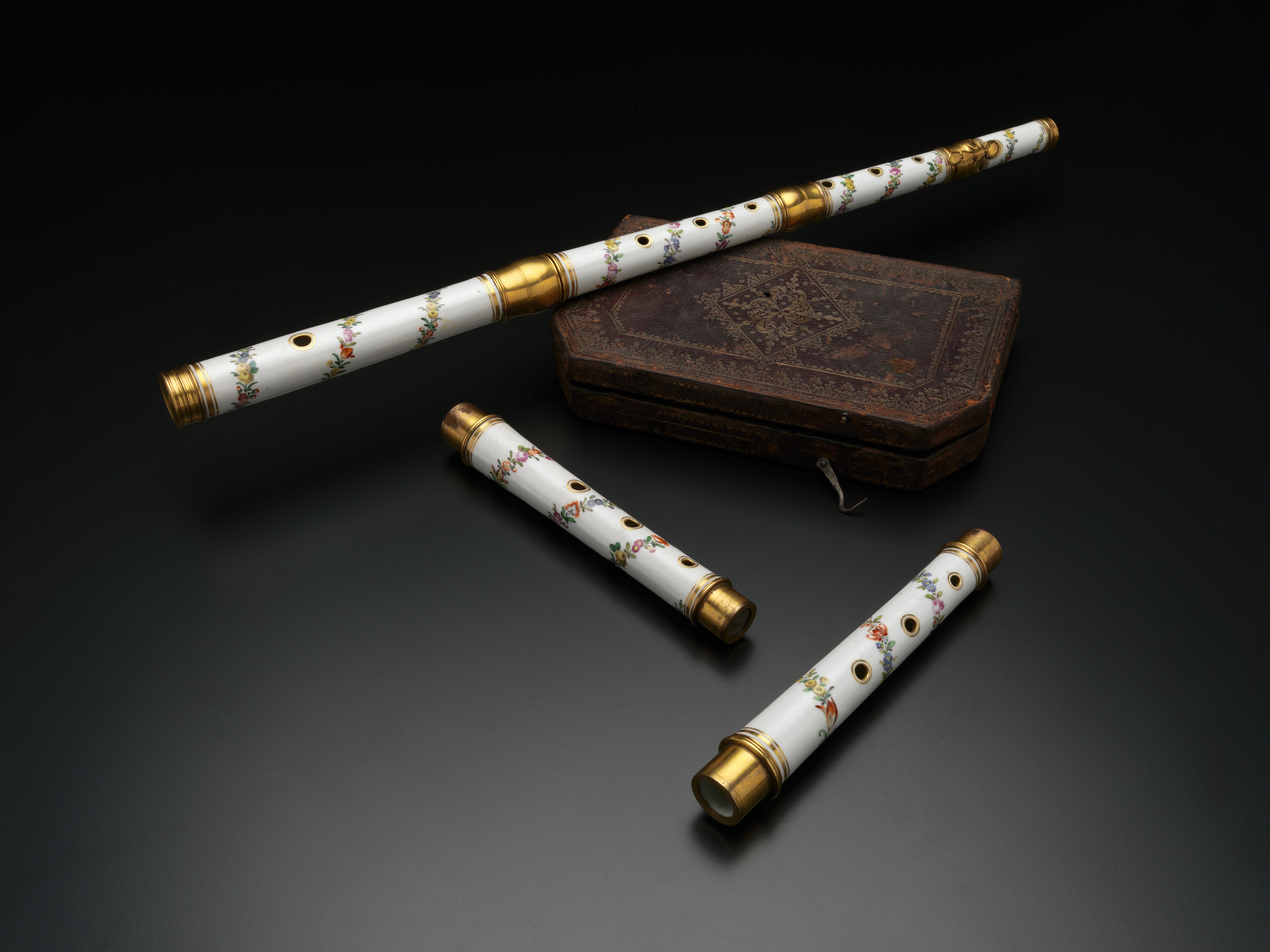
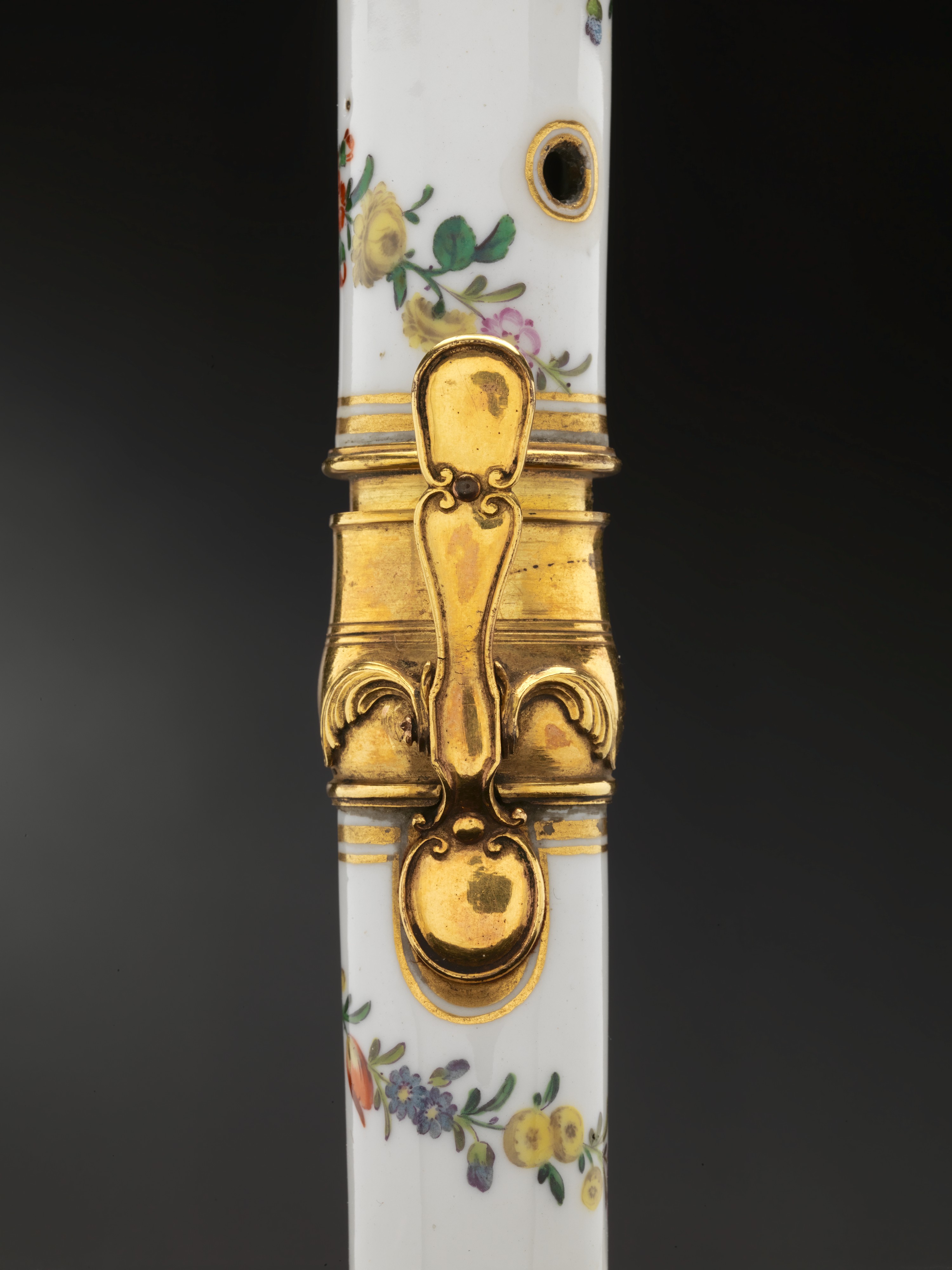
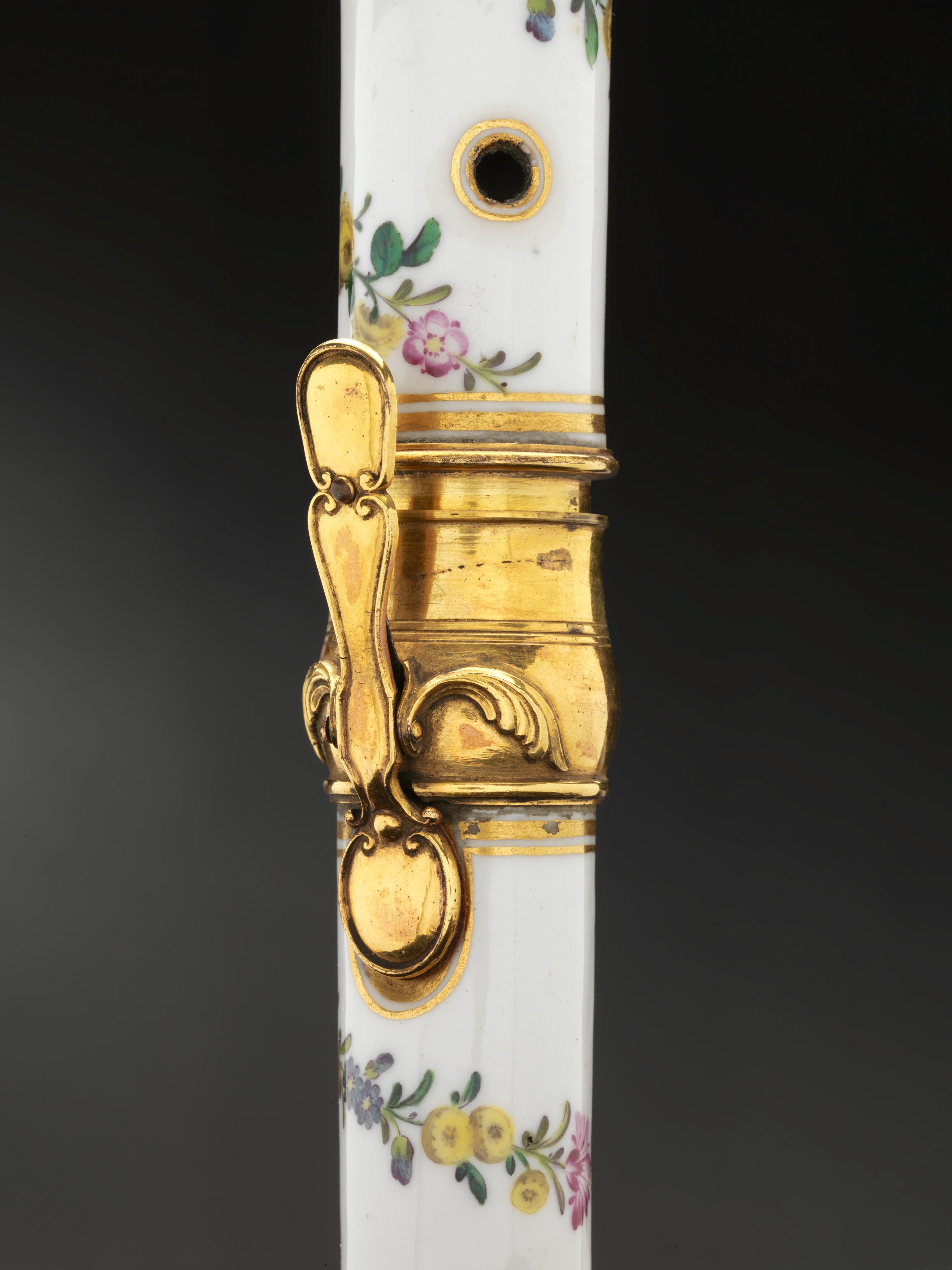
Through the late 18th and early 19th centuries makers added keys one by one to handle the chromatic notes that the six basic finger holes could not produce in tune. The MET collection documents the experimental phase in unusual material range: object 504019 is a German hard-paste-porcelain transverse flute in D-flat from 1760 to 1790; object 501534 is an 1813 French glass flute (Claude Laurent’s celebrated Paris workshop); object 505093 is an American silver flute of 1860-65; object 505147 is a mid-19th-century fruitwood instrument made for the European-American mass market. Together they show makers trying every plausible material between Bach and Boehm.
Theobald Boehm published his cylindrical-bore key system in 1847 in Munich. He had patented an earlier conical-bore version in 1832; the 1847 design replaced the conical bore with a cylindrical one, fixed the key positions on acoustic rather than ergonomic grounds, and added the open-G-sharp mechanism that made the chromatic scale possible without forked fingerings. Within thirty years the Boehm system had become the world standard for the concert flute. The wooden conical-bore Romantic flute survived in some folk traditions (the Irish flute being the largest such pocket; see also low whistle and Irish flute) but vanished from professional orchestral playing.
Construction & Materials
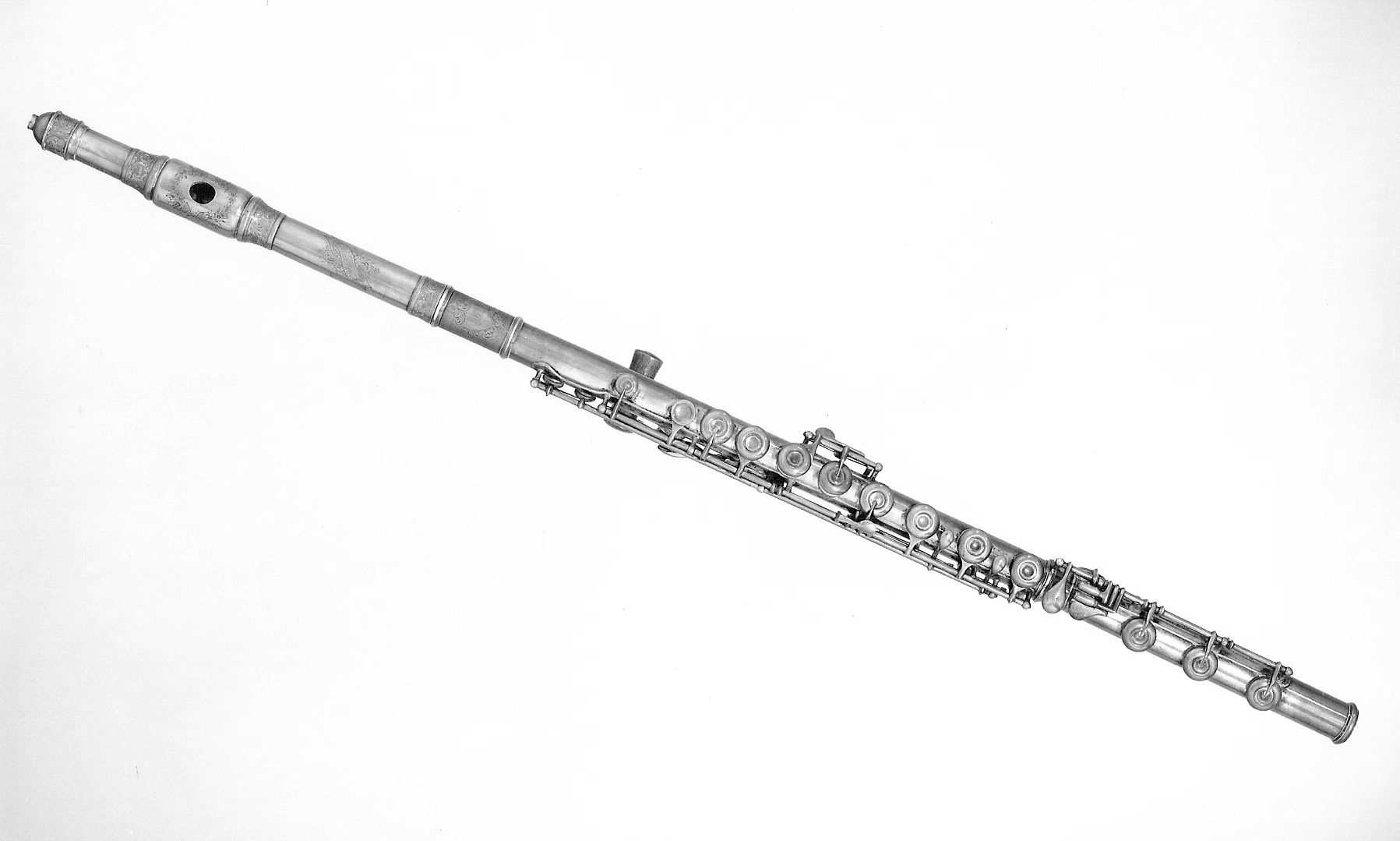
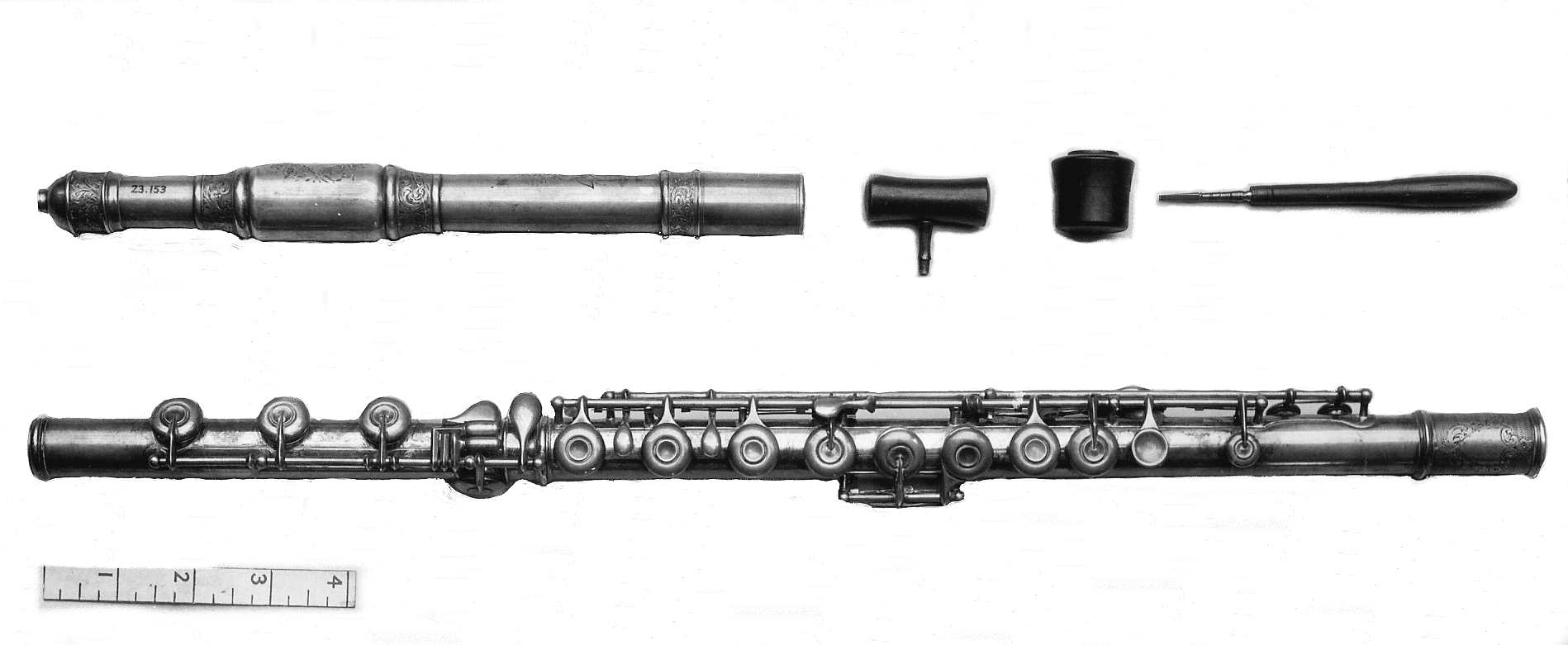
The modern concert flute is built in three sections: the head joint (with the embouchure hole and lip plate), the body (with most of the keys), and the foot joint (with the lowest keys, ending at C4 on the standard model or B3 on the longer “B-foot” model). Total length is about 67 cm.
Materials follow a price ladder. Student instruments are typically nickel-silver plated with silver. Intermediate instruments use solid silver head joints on nickel-silver bodies. Professional instruments use solid silver throughout, sometimes with gold or platinum head joints; some professional players use grenadilla-wood instruments built on the Boehm system for a darker tone. The mechanism — about sixteen keys, rods, springs, and pads — is one of the most mechanically refined parts of any woodwind.
How It’s Played
The player holds the instrument horizontally to the right, with the embouchure hole against the lower lip. Sound is produced by directing a focused, controlled airstream across the hole; the exact angle, distance, and shape of the player’s lips determine pitch, dynamic, and timbre. The left hand fingers the upper keys; the right hand fingers the lower keys and operates the foot joint.
The standard playing range is three octaves from middle C upward; advanced players reach a fourth octave. Articulation includes single, double, and triple tonguing for fast passages, flutter-tongue, and the wide range of extended techniques codified in 20th-century repertoire — multiphonics, key clicks, jet whistle, microtonal alternate fingerings.
Cultural Significance
The concert flute is one of the standard woodwinds of the symphony orchestra, the wind quintet, and the modern wind ensemble, and it carries a substantial solo and chamber repertoire. The Mozart concertos (K. 313 and K. 314), the Bach Sonatas, the Reinecke and Nielsen concertos, and the Prokofiev, Khachaturian, Ibert, and Jolivet concertos define the canonical solo repertoire; Debussy’s Syrinx (1913) is the canonical solo-flute miniature.
The instrument also has a strong jazz and Latin presence: Hubert Laws, Herbie Mann, Yusef Lateef, James Newton, and the Cuban charanga tradition (Belisario López, Richard Egües) have built entirely separate playing styles on the same Boehm-system instrument. In modern crossover and global-music contexts, the concert flute often substitutes for or doubles wooden traditional flutes in studio recordings of folk material.
Notable Examples & Recordings
- Marcel Moyse, Tone Development Through Interpretation (the foundational 20th-century French-school pedagogy text and recorded reference).
- Jean-Pierre Rampal — the recordings that effectively re-established the flute as a solo concert instrument in the post-war period (Bach, Mozart, Vivaldi).
- James Galway, Man with the Golden Flute — the most commercially successful flute artist of the late 20th century.
- Emmanuel Pahud, Sharon Bezaly, Aurèle Nicolet — current leading orchestral and solo voices.
- Hubert Laws’s Rite of Spring (CTI, 1972) and Herbie Mann’s At the Village Gate — jazz reference.
Related Instruments
- Piccolo — the same Boehm system at half the length, sounding an octave higher.
- — a fourth lower; standard auxiliary in modern orchestral writing.
- — an octave below the concert flute.
- Irish flute — the conical-bore wooden Romantic-era design that survived in Irish traditional music.
- Recorder — the unrelated end-blown duct-flute family.
- Bansuri — the North Indian transverse bamboo flute.
- Dizi — the Chinese transverse bamboo flute with a buzzing membrane.
- Shakuhachi — the Japanese end-blown bamboo flute.
Where to Hear It
In every full-time symphony orchestra in the world. Major concerto and recital festivals include the British Flute Society Convention, the National Flute Association annual convention in the US, the Adams Flute Festival in the Netherlands, and the Galway Flute Festival in Switzerland. Recording labels with deep flute catalogues include Naxos, BIS, Hyperion, Deutsche Grammophon, and Chandos.
- Wikipedia: Western concert flute
- Wikidata: Western concert flute (Q209554)
- DBpedia: Western concert flute
- MET Object 504019 (German porcelain flute, 1760-90)
- MET Object 501534 (Laurent French glass flute, 1813)
- MET Object 505093 (American silver flute, 1860-65)
- Wikimedia Commons: Concert flutes
Learning Resources
A new student concert flute (Yamaha YFL-222, Pearl 505, Trevor James 10X) costs 600 to 1,200 USD. Intermediate solid-silver-head models run 1,500 to 3,500 USD. Professional handmade instruments from Powell, Brannen, Muramatsu, Sankyo, Haynes, or Nagahara start around 8,000 USD and run upward to 30,000 USD or more for solid-gold flutes. Standard pedagogy: the Trevor Wye Practice Books (six volumes), Marcel Moyse’s De la Sonorité, Taffanel and Gaubert’s Méthode Complète, and the Reichert Daily Exercises.
Frequently Asked Questions
Why is the concert flute made of metal rather than wood?
Theobald Boehm’s 1847 design was originally conceived for a metal cylindrical bore; he found that silver gave the brightness and projection his key system was engineered around. Wood Boehm flutes exist and are used by some orchestral players for tonal variety, but silver remains the standard.
How long does it take to learn?
Recreational competence within one to two years of regular study; standard student concerto repertoire (Mozart concertos, Bach sonatas) typically within seven to ten years; professional auditions assume daily practice from childhood through conservatory.
Is the concert flute the same as a Boehm flute?
Yes. The 1847 Boehm key system is what defines the modern concert flute and distinguishes it from earlier conical-bore designs.
Why does my flute sound flat or sharp on certain notes?
The instrument is acoustically tuned for a specific embouchure-and-air pattern. Persistent intonation issues on particular notes are usually a function of embouchure shape, air angle, and head-joint position rather than instrument malfunction.
What is the difference between a C-foot and a B-foot flute?
The B-foot adds about 4 cm to the foot joint and lets the instrument play one extra semitone (B3) below the standard C4. Most professional flutes are B-foot; most student instruments are C-foot.


