.jpg)
.jpg)
.jpg)
Nyckelharpa
nyckelharpa
| Category | Strings |
|---|---|
| Country of origin | Sweden |
| Classification | type of musical instrument |
| Wikipedia | en.wikipedia.org |
| Wikidata | Q182718 |
Listen
Audio: Fred Black, CC BY-SA / via Internet Archive

Overview
The nyckelharpa is a Swedish keyed fiddle: a bowed string instrument whose pitches are changed not by the player’s fingers pressing directly on the strings, but by a row of small wooden keys mounted along the side of the neck. Each key, when pressed, lifts a small tangent against one of the melody strings to change its sounding length. A bow draws across the strings as on a violin or viola, while the keys do the work of fingering.
The Hornbostel-Sachs system classifies the nyckelharpa as 321.322 — a composite chordophone — which it shares with its more famous cousin the hurdy-gurdy, although the two instruments differ in that the nyckelharpa is bowed by hand while the hurdy-gurdy is sounded by a mechanical wheel.
Origin & History
Documentation of the nyckelharpa in Sweden goes back to the late medieval period. DBpedia places its development in the 12th century, and surviving carvings from that era — including a famous one in Källunge Church on Gotland from around 1350 — show clear ancestor instruments. Wikipedia notes that the instrument has been built and performed in Sweden since the 1600s in a form recognisable to a modern player.
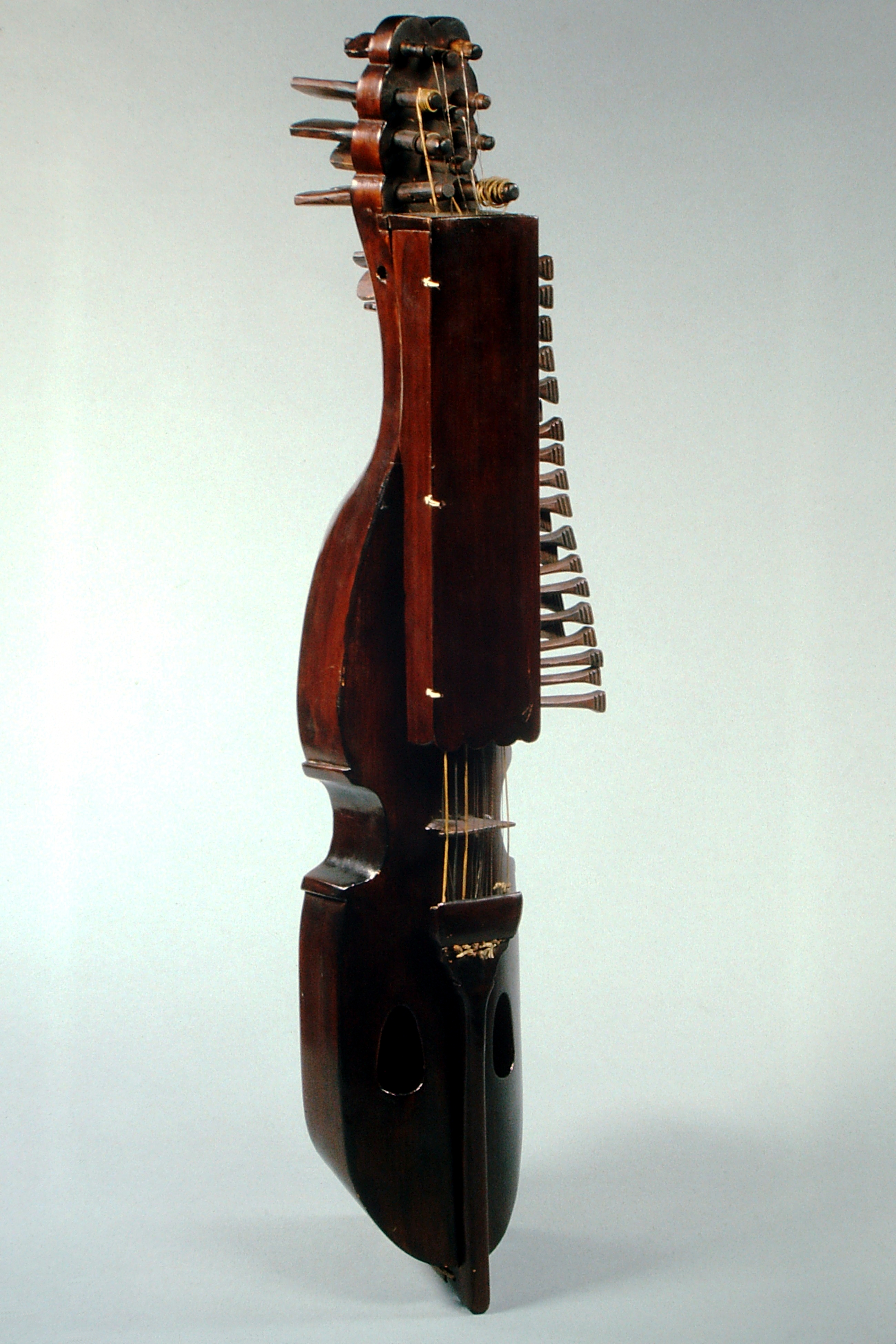
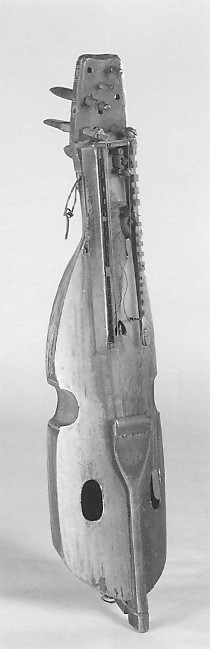
The Metropolitan Museum of Art holds two surviving Swedish nyckelharpas: a late-18th-century example (object 503064) made of wood and various other materials, and a 19th-century example (object 501567) similarly constructed. Both document the instrument as it stabilised through the early modern period, with simpler key layouts than the modern kromatisk nyckelharpa but the same basic design.
By the opening decades of the 1900s, the nyckelharpa had nearly disappeared outside Uppland — and even in that province only a handful of older musicians still played it. The modern kromatisk nyckelharpa, a fully chromatic three-row keyboard version with sympathetic strings, was developed in the 1920s and 1930s, principally by the player and maker August Bohlin. From the 1960s onward a sustained revival, led by players such as Eric Sahlström and his many students, brought the instrument back into wide use across Sweden and into international visibility through performers including Olov Johansson and the band Väsen.
Construction & Materials
A modern kromatisk nyckelharpa is built around a wooden body resembling a small lute or violin, with a flat soundboard and a long neck. Three rows of keys (forty or so in total) are mounted along the right side of the neck, each carrying a small tangent on its inner side. Three or four melody strings run over the keys, and a bank of around twelve sympathetic strings runs underneath the soundboard, vibrating freely when the melody strings are bowed.
The MET’s two 19th- and late-18th-century specimens (objects 501567 and 503064) document the simpler historical layouts: fewer keys, fewer rows, and (in the older specimen) no chromatic capability. Body materials have remained broadly stable across the centuries, with spruce or pine soundboards and birch, maple, or other northern-European hardwoods for the back, sides, and neck.
How It’s Played
The player wears the nyckelharpa across the body on a strap, with the body resting against the abdomen or right hip and the keyboard along the side of the neck facing the player’s left hand. The right hand bows the melody strings; the left hand presses the keys, with each key handling one specific pitch.
Because each key handles a single pitch — rather than a finger sliding to find a note as on a violin — intonation is fixed by the position of the tangents. This makes the nyckelharpa more accessible than a violin in some respects (no fingerboard work) and less flexible in others (no continuous slides between pitches). The bank of sympathetic strings adds the instrument’s characteristic shimmering halo of sound, particularly evident in the slow Swedish polskor dance tunes for which the nyckelharpa is best known.
Cultural Significance
The nyckelharpa is closely tied to the traditional dance music of the Swedish region of Uppland — particularly the polska repertoire — and to Swedish folk music more broadly. After centuries as a regional instrument and decades as a near-extinct one, the modern kromatisk nyckelharpa and the revival movement around Eric Sahlström have made it one of the most internationally recognised Nordic folk instruments today.
The Eric Sahlström Institute in Tobo, Sweden, founded in 1998, has played a central role in training new players and makers and in promoting the instrument internationally. Players such as Olov Johansson (of Väsen) and Marco Ambrosini have helped extend the nyckelharpa’s reach into early-music ensembles, contemporary composition, and cross-cultural projects with musicians from outside the Swedish tradition.
Notable Examples & Recordings
The Metropolitan Museum of Art’s late-18th-century and 19th-century Swedish nyckelharpas (objects 503064 and 501567) document the historical form of the instrument and are particularly useful as a contrast with the modern kromatisk design. For listening, recordings by Eric Sahlström, Olov Johansson, the band Väsen, and the Swedish-Italian player Marco Ambrosini together cover the instrument’s traditional, contemporary, and cross-cultural ranges.
Related Instruments
- Hurdy-gurdy – the wheel-bowed cousin in the same broad family of keyed string instruments
- Hardanger fiddle – the Norwegian sympathetic-string fiddle, a related Nordic tradition
- – the generic term for the violin family in folk music contexts
- Violin – the broader bowed-string family to which the nyckelharpa belongs by Hornbostel-Sachs class
- – the Renaissance Italian bowed instrument with sympathetic-string aesthetic
Where to Hear It
Swedish folk-music festivals, particularly in the Uppland region (Bingsjöstämman, Eric Sahlström-stämman), are the natural settings for the nyckelharpa. The instrument also appears regularly in Nordic folk recordings, in early-music ensembles, and in contemporary Nordic composition.
- Wikipedia: Nyckelharpa
- The MET: Nyckelharpa, late 18th century (object 503064)
- The MET: Nyckelharpa, 19th century (object 501567)
- Wikimedia Commons: Nyckelharpa
Learning Resources
The Eric Sahlström Institute in Tobo, Sweden, runs full-time and short-course training for both players and makers. Several leading players also offer structured online tuition, and most major European folk-music conservatories now include the nyckelharpa in their teaching programmes. Beginners typically start by learning to bow cleanly across the open strings before progressing to the keys and to the basic Swedish polska repertoire.
Frequently Asked Questions
Where does the nyckelharpa come from?
Documentation of the instrument in Sweden reaches back to the late medieval period, with carved depictions appearing as early as the 1300s. By the opening years of the twentieth century it was nearly extinct outside Uppland, and it has since been revived through dedicated work by makers, players, and the Eric Sahlström Institute since the mid-20th century.
How is the nyckelharpa different from a violin?
The nyckelharpa is bowed like a violin, but its pitches are changed by pressing keys mounted along the side of the neck rather than by fingering the strings directly. It also typically carries a bank of sympathetic strings beneath the soundboard, which give it a distinctive shimmering resonance.
What is the kromatisk nyckelharpa?
The kromatisk nyckelharpa is the fully chromatic modern variant of the instrument, developed in the 1920s and 1930s principally by August Bohlin. It has three rows of keys (around 40 in total) and is the standard variant played in Sweden and internationally today.
Are old nyckelharpas displayed in museums?
Yes. New York’s Metropolitan Museum of Art holds at least two well-documented Swedish nyckelharpas (objects 501567 and 503064), spanning the late 18th and 19th centuries.
Is the nyckelharpa difficult to learn?
The basics of bowing and pressing single keys are reasonably accessible. Full fluency on the kromatisk keyboard and stylistic command of the Swedish polska repertoire typically take several years of structured study.


